AI Cloud Integration for BFSI Network Monitoring: Why It Matters and How to Get It Right
AI cloud integration for BFSI network monitoring refers to the use of artificial intelligence and cloud-native platforms to deliver real-time visibility, predictive analytics, and automated incident response across the hybrid IT environments that power banking, financial services, and insurance operations.
Hook
A single minute of network downtime can cost a financial services firm upward of $9,000 — and that number climbs fast. When you're running billions in daily transactions across hybrid infrastructure that spans legacy core banking systems, mobile apps, payment gateways, and cloud workloads, traditional monitoring tools simply can't keep up. AI and cloud integration aren't optional upgrades for BFSI networks anymore — they're the baseline for staying operational, compliant, and competitive.
Why Legacy Monitoring Can't Keep Up with Modern BFSI Networks
Hybrid BFSI networks in 2026 are complex ecosystems with tightly interdependent components:
Core banking systems (CBS) hosted on legacy on-premises infrastructure.
Customer-facing digital platforms like mobile banking apps and online trading portals.
Third-party integrations for KYC, AML, and payment gateways.
Distributed edge devices including ATMs and POS systems.
Traditional network monitoring tools are rule-based and reactive. They trigger alerts on static thresholds, which means alert fatigue and slow incident resolution are everyday problems.
Forrester reports that 56% of BFSI firms have adopted at least one public cloud service. Cloud components introduce variables like dynamic IP addressing, containerization, and auto-scaling — all beyond what legacy tools were designed to handle.
Here's where legacy monitoring falls short:
Capability | Legacy Tools | AI-Driven Tools |
|---|---|---|
Hybrid visibility | Siloed views, blind spots | Unified dashboards across on-prem and cloud |
Dynamic scaling | Can't track resource changes | Auto-discovers and tracks scaling events |
Compliance reporting | Manual audits, limited coverage | Automated reports for PCI DSS, GLBA |
Threat detection | Signature-based, reactive | Behavioral analysis, predictive alerts |
Root cause analysis | Manual correlation | Automated RCA with telemetry correlation |
How AI-Driven Monitoring Solves BFSI Network Challenges
AI-powered network monitoring addresses every limitation listed above. It uses advanced analytics, machine learning, and process automation to deliver capabilities built for modern financial infrastructure:
Unified Observability. AI platforms like Motadata AIOps consolidate logs, metrics, and traces from all on-premises, cloud, and hybrid assets. This gives teams instant end-to-end visibility and faster root cause analysis.
Behavioral Anomaly Detection. Machine learning engines continuously analyze network traffic and user behavior, identifying anomalous patterns and detecting potential threats the moment they appear.
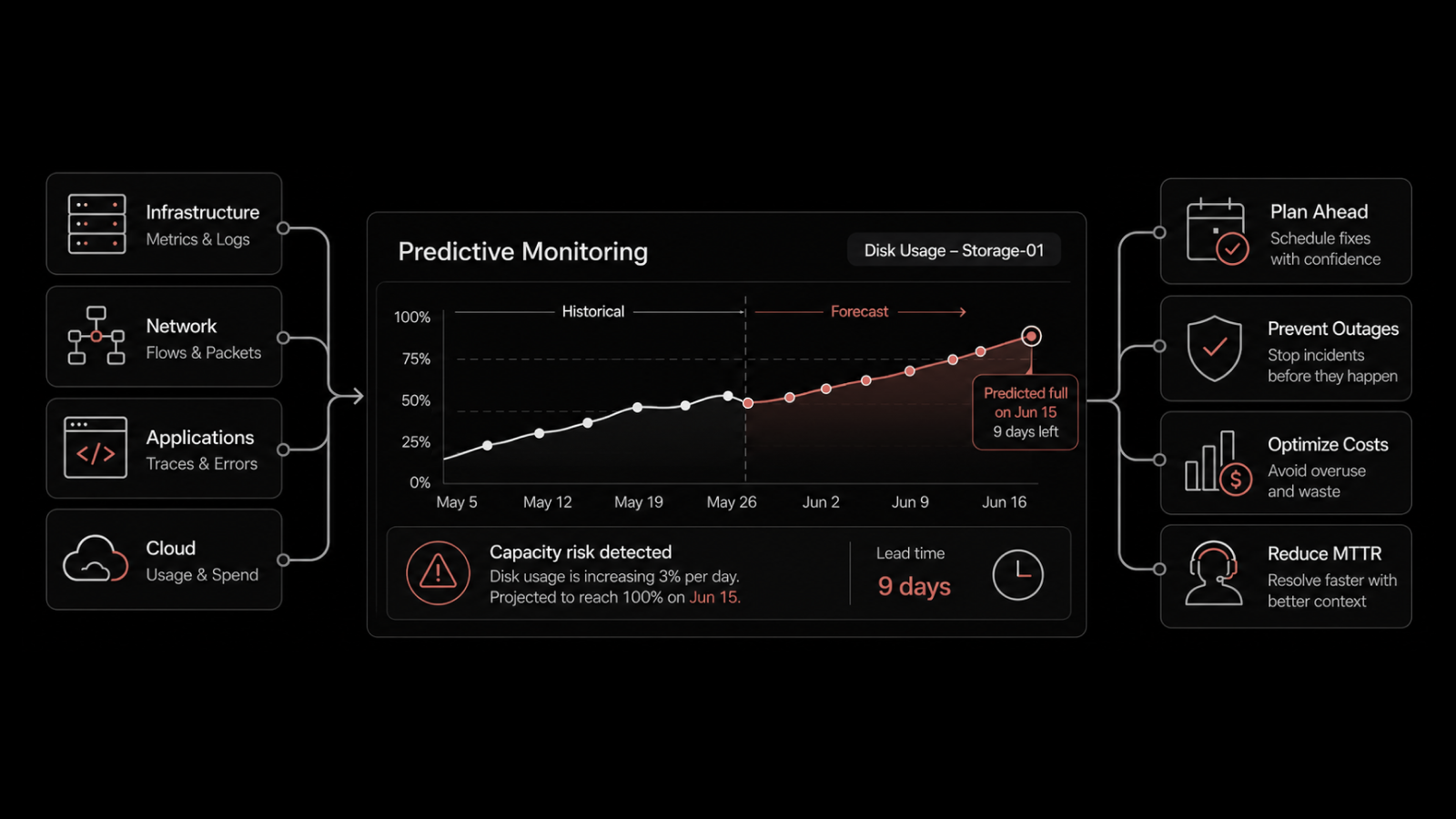
Predictive Maintenance. AI engines examine historical data to forecast equipment failures, security incidents, or network congestion — putting teams in a preventive position rather than a reactive one.
Automated Response. When the right triggers fire, AI-ML systems kick off automated workflows — rerouting traffic, isolating compromised assets, or rolling back faulty configurations in seconds.
Elastic Scaling. AI-powered monitoring tools scale their capacity in lockstep with the growth in assets, transactions, and network complexity across an evolving BFSI environment.
Advanced Baseline Intelligence. AI frameworks analyze real-time telemetry across hybrid environments, setting behavioral baselines and detecting anomalies that go beyond simple pattern matching.
Core Components of an AI-Powered BFSI Monitoring Stack
Any production-grade AI network monitoring system includes these operational layers:
Data Collection and Aggregation
The platform ingests large volumes of structured and unstructured data from network endpoints — network devices, application logs, cloud APIs, and more. This data lake forms the foundation for meaningful analysis and actionable insights.
Real-Time Analytics and Alerting
AI tools run continuous analysis across all monitored systems, immediately detecting performance degradation, security breaches, or compliance violations. Alert configurations prioritize critical incidents, reduce noise, and make sure the right teams respond at the right time.
Predictive and Prescriptive Insights
AI-based monitoring platforms don't just predict future issues — they recommend optimization steps and trigger corrective actions. They can automate compliance scans, build audit trails, and flag policy violations across hybrid environments.
Measurable Benefits of AI Network Monitoring in Banking and Finance
Downtime Prevention
AI analyzes historical performance data and real-time traffic to predictively maintain network health and proactively identify bottlenecks and threats.
The cost of downtime for financial services organizations is $152 million annually.
AI tools automate RCA by correlating telemetry data — logs, metrics, events — so IT teams resolve incidents faster and reduce MTTR (Mean Time to Resolution). Less downtime means lower costs and fewer revenue-impacting outages.
Stronger Customer Experience
AI-driven monitoring keeps pace with a sector where milliseconds matter. It triangulates deviations from performance benchmarks across every customer touchpoint — delivering smooth digital banking experiences, real-time payment processing, and uninterrupted trading activity.
Dynamic Resource Optimization
AI models continuously optimize network resource allocation based on real-time demand. During peak usage periods — payroll processing, end-of-quarter reporting — critical banking applications maintain acceptable performance levels without manual intervention.
Improved Security Posture
Monitoring systems enhanced with AI identify anomalies in network behavior that often signal security breaches or data theft attempts. The AI engine scans performance and security metrics so BFSI firms can predict attacks, strengthen cyber resilience, and maintain operational efficiency.
Compliance and Audit Readiness
AI-powered monitoring tools generate automated reports that align with regulatory requirements — PCI DSS, GLBA, and local data protection laws — specific to the BFSI domain. Continuous compliance checks reduce manual audit burdens and minimize legal risk.
Cost Savings and ROI
Fewer unplanned outages plus optimized resource usage equals reduced operational costs. AI-driven network monitoring directly contributes to maximizing ROI and protecting revenue.
Better Cross-Team Collaboration
AI engines feed monitoring insights into ITSM and AIOps workflows, enabling cross-functional teams — IT, compliance, security — to find and prioritize incidents that threaten critical business functions.
Best Practices for AI and Cloud-Integrated BFSI Monitoring
Successful implementation depends on more than technical deployment. It requires a comprehensive approach that covers security, compliance, and user experience.
Invest in Banking Domain Application Testing
Digital-first BFSI apps are interconnected — core banking systems, mobile apps, and third-party integrations are tightly coupled. Teams need banking application testing to verify that monitoring solutions can:
Simulate high-volume transactions and validate monitoring tools under peak load — payroll cycles, end-of-quarter surges.
Meet compliance requirements for PCI DSS and GLBA by securely handling sensitive customer data.
Maintain low latency and prevent service disruptions in end-to-end customer workflows.
Integrate cleanly with existing apps and legacy banking platforms.
Prioritize Predictive Analytics
Move beyond reactive monitoring by embedding predictive analytics into your stack. Use historical performance data and real-time telemetry to forecast potential issues like network congestion or payment gateway overloads before they hit production.
Integrate with ITSM and AIOps Workflows
When AI-driven monitoring tools connect with ITSM and AIOps platforms, teams can:
Automate ticket creation when incidents occur.
Map performance issues to changes in protocols, codebase, or operational processes.
Use automated playbooks for faster incident resolution.
Establish Continuous Compliance
BFSI compliance isn't a one-time checkbox — it's an ongoing operational requirement. AI-based monitoring tools should incorporate:
Automated compliance reports that support auditor workflows.
Integrated security controls — data encryption and access management native to cloud platforms (AWS, Azure, GCP).
Continuous monitoring for anomalies that could indicate security threats.
Why Motadata for BFSI Network Monitoring
Motadata's AI-native AIOps platform is built for the kind of hybrid, high-stakes environments that BFSI organizations operate in. It unifies logs, metrics, and traces into a single observability layer, automates root cause analysis, and integrates directly with ITSM workflows through Motadata ServiceOps. Whether you're monitoring core banking systems, cloud workloads, or edge devices like ATMs and POS terminals, Motadata gives your team the real-time visibility and predictive intelligence to stay ahead of incidents — not chase them. Start a free trial and see how AI-native monitoring transforms your BFSI operations.
FAQs
How does AI improve network monitoring in BFSI environments?
AI applies machine learning to detect anomalies, predict failures, and automate root cause analysis. It shifts BFSI teams from reactive incident response to proactive prevention, reducing downtime and keeping banking operations running smoothly.
Why is cloud integration critical for network monitoring in BFSI?
Cloud integration provides the scalability, agility, and unified view that hybrid BFSI environments demand. It delivers real-time insights across on-premises and cloud assets without requiring teams to manage separate monitoring stacks.
How do AI and cloud solutions ensure regulatory compliance?
AI-powered monitoring systems automate compliance reporting for standards like PCI DSS and GLBA. The AI engine continuously scans processes and documents, flagging violations before they become audit findings.
How does banking application testing support BFSI monitoring transformation?
Banking application testing validates that monitoring solutions perform under BFSI-specific conditions — high transaction volumes, strict security requirements, and complex integrations with legacy platforms. It confirms performance, compliance, interoperability, and customer experience quality before go-live.
What's the cost impact of AI-driven monitoring in financial services?
Financial services organizations lose an average of $152 million annually to downtime. AI-driven monitoring reduces unplanned outages, speeds up incident resolution, and optimizes resource usage — delivering measurable cost savings and stronger ROI.
Author
Arpit Sharma
Senior Content Marketer
Arpit Sharma is a Senior Content Marketer at Motadata with over 8 years of experience in content writing. Specializing in telecom, fintech, AIOps, and ServiceOps, Arpit crafts insightful and engaging content that resonates with industry professionals. Beyond his professional expertise, he is an avid reader, enjoys running, and loves exploring new places.