Service Level Objectives (SLOs): How to Align Observability with Business Outcomes
In the digital economy, every second matters. Systems don't just run your business — they are your business. CIOs and CTOs face a daily challenge: how do you ensure technology delivers the outcomes your customers expect while keeping costs, risks, and complexity in check?
The answer lies in three letters: SLO (Service Level Objective).
A Service Level Objective (SLO) is an internal reliability target that defines the acceptable level of performance or availability for a service over a specific period. SLOs bridge the gap between raw observability data and the business outcomes that matter to customers, revenue, and operations.
SLOs transform observability from a dashboard of numbers into a framework for delivering reliability that customers can feel. Without them, monitoring tools generate data but lack direction. With them, every alert, every metric, and every response connects to a measurable business commitment.
SLO vs. SLA vs. SLI: Understanding the Differences
Before diving into SLO implementation, it's important to understand how SLOs relate to the other two pillars of service reliability.
Concept | Definition | Audience | Example |
|---|---|---|---|
SLI (Service Level Indicator) | A quantitative measurement of service behavior | Engineering teams | 99.7% of API requests complete in under 200ms |
SLO (Service Level Objective) | An internal reliability target based on SLIs | Engineering + leadership | API latency p99 must stay below 200ms, 99.5% of the time |
SLA (Service Level Agreement) | A contractual commitment with consequences for breach | Customers + legal | 99.9% uptime guaranteed; credits issued below threshold |
SLIs feed into SLOs. SLOs inform SLAs. Think of SLIs as the raw measurements, SLOs as the internal goals, and SLAs as the external contracts. Organizations that skip SLOs and jump straight from metrics to SLAs often set unrealistic targets or fail to detect reliability degradation before it hits contractual thresholds.
How SLOs Transform Observability
Availability SLOs: Keep the Lights On
When systems go dark, so does revenue. Availability SLOs ensure critical services stay up and running when your business and customers need them most.
Business outcomes by industry:
E-commerce: Every second of downtime is lost cart revenue. High-availability SLOs safeguard peak sales moments like flash sales and holiday seasons.
Banking and FinTech: Availability SLOs assure customers their money moves safely around the clock, building trust in digital banking channels.
Healthcare: Patients access records, appointments, and telehealth portals without interruption — availability SLOs protect the care experience.
CIOs who embrace availability SLOs turn uptime into trust, and trust into loyalty.
Performance SLOs: Speed Fuels Satisfaction
Slow is the new down. Performance SLOs ensure systems respond at the speed of customer expectations.
Business outcomes by industry:
SaaS and collaboration platforms: Fast load times drive adoption and reduce churn. A 100ms latency improvement can measurably increase user engagement.
Telecom: Low-latency SLOs keep customers connected without frustration, directly impacting net promoter scores.
Retail: Quick checkout experiences prevent abandoned carts and protect conversion rates.
CTOs who adopt performance SLOs deliver more than speed — they deliver delight that keeps customers engaged and competitors at bay.
Event SLOs: Signal Over Noise
In a sea of alerts, event SLOs filter chaos into clarity. They help teams focus on what truly matters — business-impacting incidents.
Business outcomes by industry:
IT services and MSPs: Reduce MTTR by focusing on SLO breaches rather than raw alert volume.
Energy and utilities: Proactively resolve anomalies before they ripple into outages.
Government and public services: Ensure citizen-facing applications remain responsive and reliable.
By adopting event SLOs, leaders swap firefighting for foresight — making IT a driver of strategy, not stress.
Error Budgets: The Innovation Safety Net
One of the most powerful concepts tied to SLOs is the error budget. An error budget represents the acceptable amount of unreliability your service can tolerate within a given period.
How it works:
If your SLO is 99.9% availability over 30 days, your error budget is 0.1% — roughly 43 minutes of allowed downtime.
As long as your service stays within budget, engineering teams can ship features, run experiments, and deploy with confidence.
When the budget runs low, teams shift focus to reliability work — hardening infrastructure, fixing flaky tests, and reducing technical debt.
Error budgets turn reliability conversations from subjective debates into data-driven decisions. They give product teams permission to innovate fast while keeping the guardrails that prevent customer impact.
SLO Best Practices
Start With Customer-Facing Services
Don't try to define SLOs for every microservice on day one. Start with the services your customers interact with directly — login flows, checkout processes, API endpoints, and dashboards.
Define SLIs Before SLOs
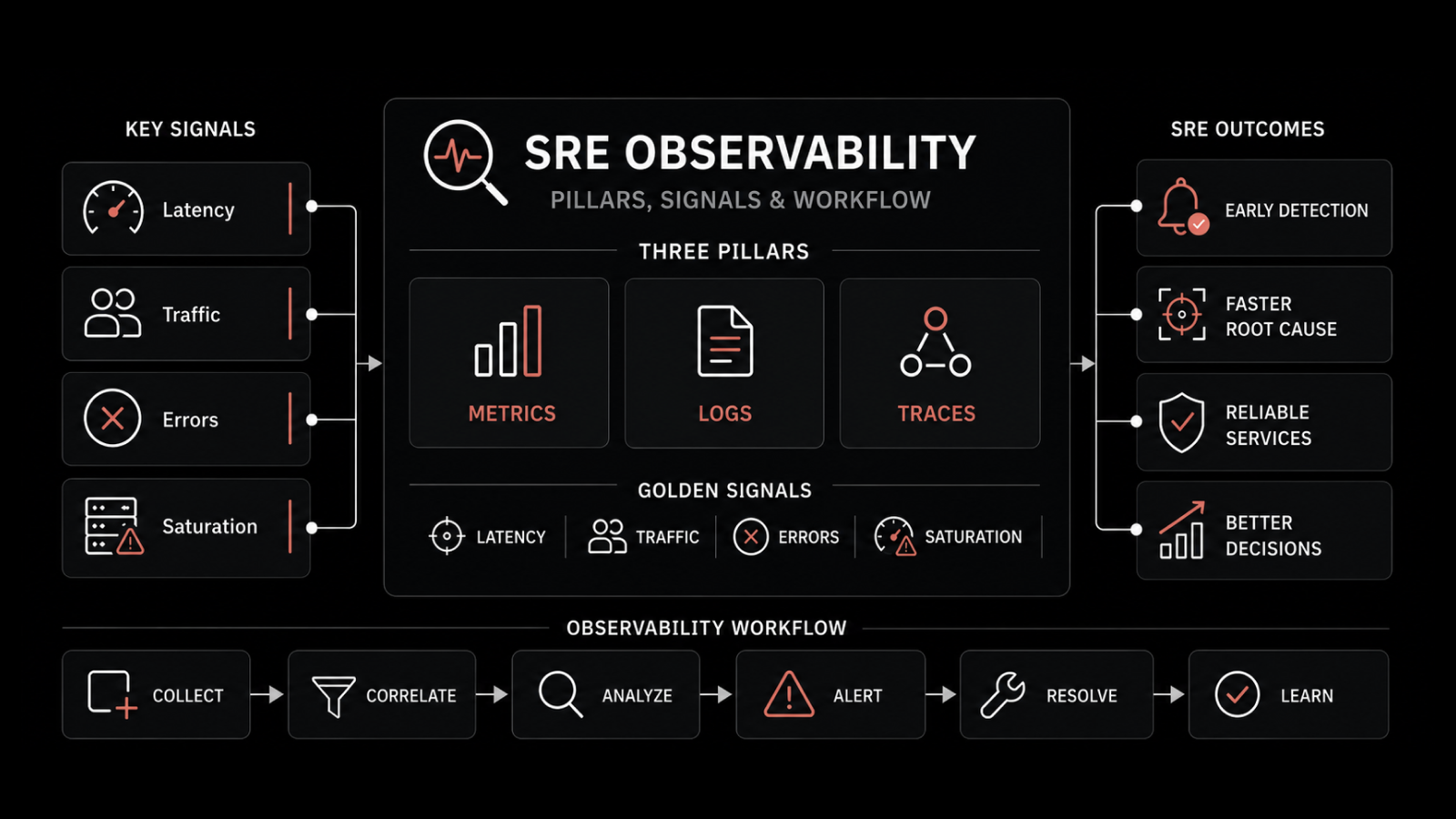
Identify the metrics that best reflect customer experience. Latency, availability, error rate, and throughput are common starting points. Your SLOs are only as good as the indicators that feed them.
Set Realistic Targets
"Five nines" sounds impressive but may not be necessary — or achievable — for every service. Set SLO targets based on customer expectations, business impact, and engineering capacity. Over-ambitious SLOs drain resources without proportional business value.
Review and Iterate
SLOs aren't set-and-forget. Review them quarterly. As your product evolves, customer expectations shift, and infrastructure changes, your SLOs should adapt accordingly.
Align SLOs With Business Outcomes
Every SLO should connect to a business metric: revenue, customer satisfaction, churn, or operational cost. If an SLO doesn't map to a business outcome, question whether it's worth tracking.
SLOs to Outcomes: Turning Metrics Into Decisions
SLOs transform observability data into meaningful, boardroom-ready narratives:
Customer trust: Consistent experiences create advocates who drive organic growth.
Revenue growth: Reliability reduces churn and powers expansion.
Risk reduction: SLOs prevent outages that damage reputation and trigger SLA penalties.
Operational efficiency: Teams resolve what matters most, faster — guided by SLO priorities rather than alert volume.
With SLOs, your observability platform stops being a dashboard of numbers and becomes a dashboard of business health.
People Also Ask
What is an SLO in observability?
A service level objective (SLO) is an internal target that defines the acceptable level of reliability or performance for a service. In observability, SLOs connect monitoring data to business outcomes by establishing thresholds that, when breached, trigger action — ensuring teams focus on the issues that impact customers and revenue.
What is the difference between SLO and SLA?
An SLO is an internal reliability goal set by engineering teams. An SLA is an external contractual commitment made to customers, often with financial penalties for breaches. SLOs are typically more aggressive than SLAs, providing a buffer that prevents SLA violations before they occur.
What is an error budget?
An error budget is the maximum amount of unreliability allowed by an SLO over a specific period. It gives engineering teams a quantitative framework for balancing feature velocity with reliability investment. When the error budget is consumed, teams prioritize stability over new releases.
How do you define good SLOs?
Good SLOs are customer-centric, measurable, realistic, and tied to business outcomes. They start with clear SLIs (service level indicators), reflect actual customer expectations rather than aspirational targets, and are reviewed regularly as the product and infrastructure evolve.
Can SLOs apply to internal services?
Yes. While SLOs are most commonly associated with customer-facing services, they're equally valuable for internal platforms — CI/CD pipelines, internal APIs, shared databases, and developer tooling. Internal SLOs improve engineering productivity and platform reliability.
Why Motadata Unified Observability for SLOs?
At Motadata, we believe observability without SLOs is like an orchestra without rhythm — all the instruments play, but there's no harmony.
Motadata Unified Observability empowers CIOs and CTOs to:
Define and track SLOs across availability, performance, and events from a single platform
Correlate IT reliability directly to customer and revenue outcomes
Monitor error budgets in real time with automated alerting when budgets are at risk
Provide a single pane of truth for business-aligned decision-making across teams
If your observability strategy is still focused on alerts and uptime dashboards, it's time to upgrade to a framework built around business outcomes.
Explore Motadata Unified Observability and start aligning your monitoring with the metrics that matter.
FAQs
How do SLOs improve incident response?
SLOs provide clear thresholds that define when a service is underperforming. When an SLO is at risk of being breached, teams receive proactive alerts that prioritize response based on business impact rather than raw alert severity. This focuses incident response on what actually matters to customers.
What tools do I need to implement SLOs?
You need an observability platform that can collect SLIs (latency, error rate, availability), define SLO targets, calculate error budgets, and alert on burn rate. Motadata Unified Observability provides all of these capabilities in a single platform.
How often should SLOs be reviewed?
Review SLOs quarterly at minimum. Major product launches, infrastructure changes, or shifts in customer expectations should trigger an ad hoc review. SLOs that haven't been updated in over six months are likely misaligned with current business needs.
Can SLOs help reduce alert fatigue?
Yes. SLOs shift alerting from threshold-based (individual metrics crossing a line) to objective-based (service reliability trending toward breach). This reduces noise by filtering out alerts that don't affect overall service health, letting teams focus on meaningful signals.
What's the relationship between SLOs and DevOps?
SLOs are a core practice in Site Reliability Engineering (SRE) and DevOps. They give cross-functional teams a shared language for reliability, provide data-driven criteria for release decisions, and create accountability through error budgets that balance speed with stability.
Author
Motadata Team
Content Team
Articles produced collaboratively by our engineering and editorial teams bear the collective authorship of Motadata Team.