6 Benefits of Network Performance Monitoring That Justify Your Investment
A single hour of network downtime costs enterprises an average of $300,000, according to Gartner's 2025 infrastructure resilience report. Yet many organizations still operate without comprehensive network performance monitoring, learning about problems only when users start complaining. That reactive approach doesn't just hurt productivity -- it erodes customer trust, revenue, and your team's ability to focus on strategic work.
Network performance monitoring (NPM) is the practice of continuously measuring, analyzing, and optimizing the health and performance of network infrastructure -- including routers, switches, firewalls, servers, and cloud resources -- to ensure availability, speed, and reliability meet defined service level objectives.
What Does Network Performance Monitoring Actually Measure?
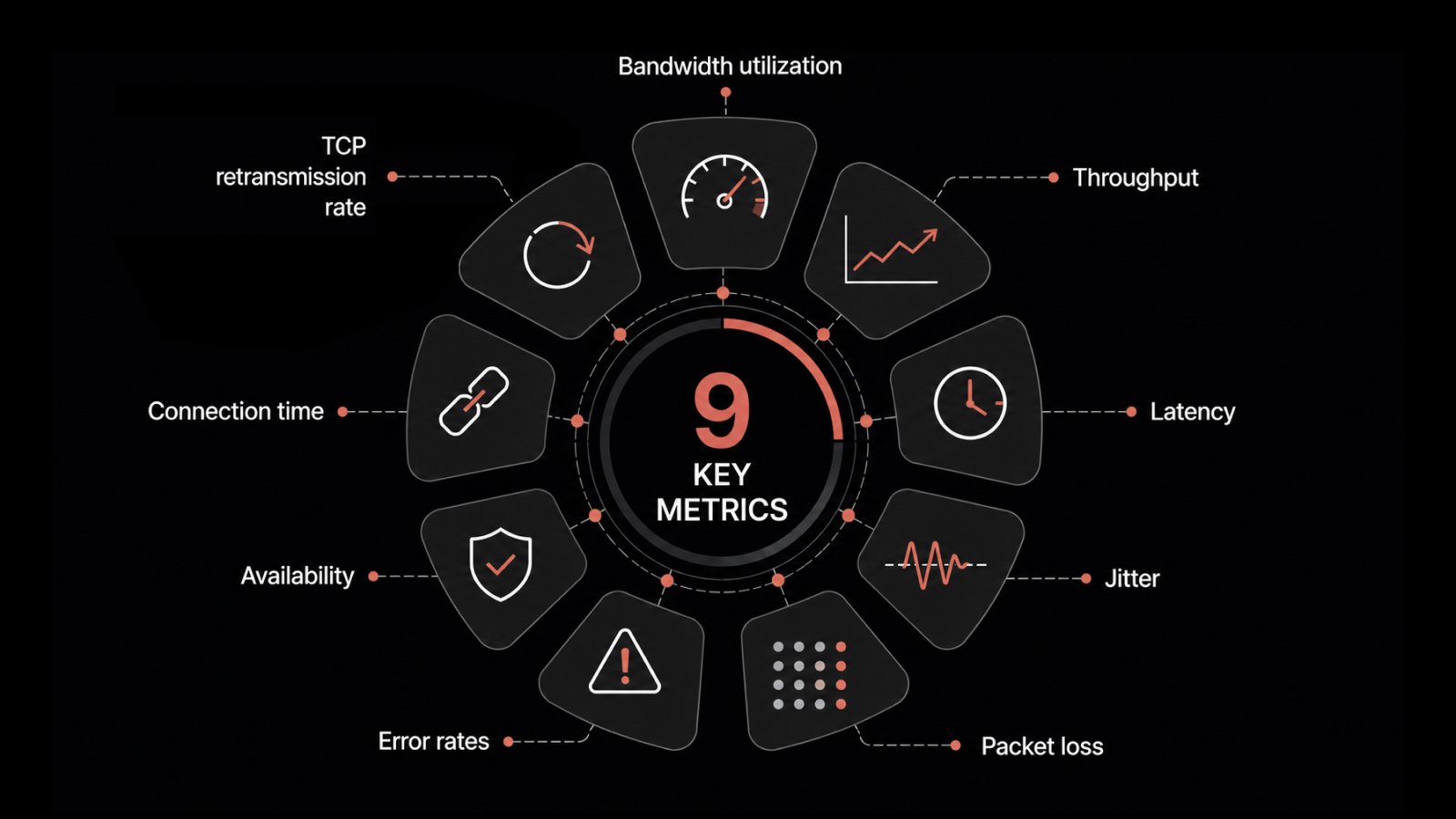
Before exploring the benefits, it's important to understand what NPM tracks. Modern network performance monitoring platforms measure a core set of metrics that together paint a complete picture of network health:
Metric | What It Measures | Why It Matters |
|---|---|---|
Latency | Round-trip time for data packets | Directly impacts user experience and application responsiveness |
Packet Loss | Percentage of packets that fail to reach their destination | Indicates congestion, hardware issues, or configuration problems |
Bandwidth Utilization | Percentage of available bandwidth in use | Reveals capacity constraints before they cause slowdowns |
Jitter | Variation in packet arrival times | Critical for VoIP, video conferencing, and real-time applications |
Availability/Uptime | Percentage of time a device or link is operational | Core SLA metric for infrastructure reliability |
MTTR | Mean Time to Resolution | Measures how quickly your team resolves incidents |
MTTD | Mean Time to Detection | Measures how fast issues are identified |
1. Stay Ahead of Outages and Downtime
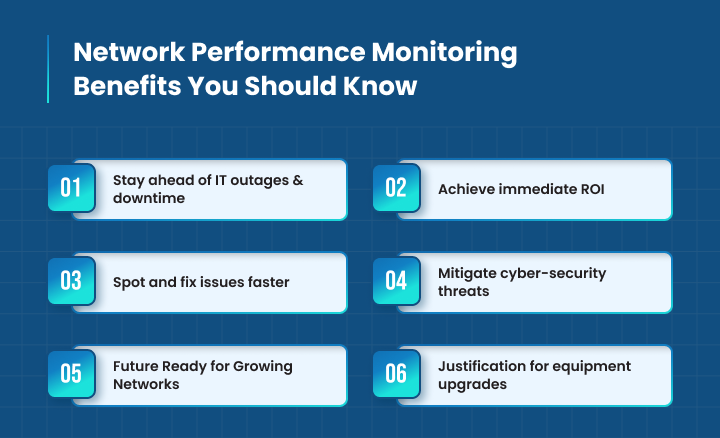
The most compelling reason to invest in NPM is simple: catching problems before they cascade into outages. According to the Uptime Institute's 2025 Annual Outage Analysis, 75% of data center outages are preventable with proper monitoring and alerting.
Here's how NPM makes that prevention possible:
Threshold-based alerting notifies your team when metrics like CPU utilization, bandwidth, or latency exceed normal ranges -- often hours before a failure occurs.
AI-driven anomaly detection identifies unusual patterns that static thresholds miss, catching the subtle warning signs of impending problems.
Dependency mapping shows how a failing component affects upstream and downstream services, enabling targeted response before the blast radius expands.
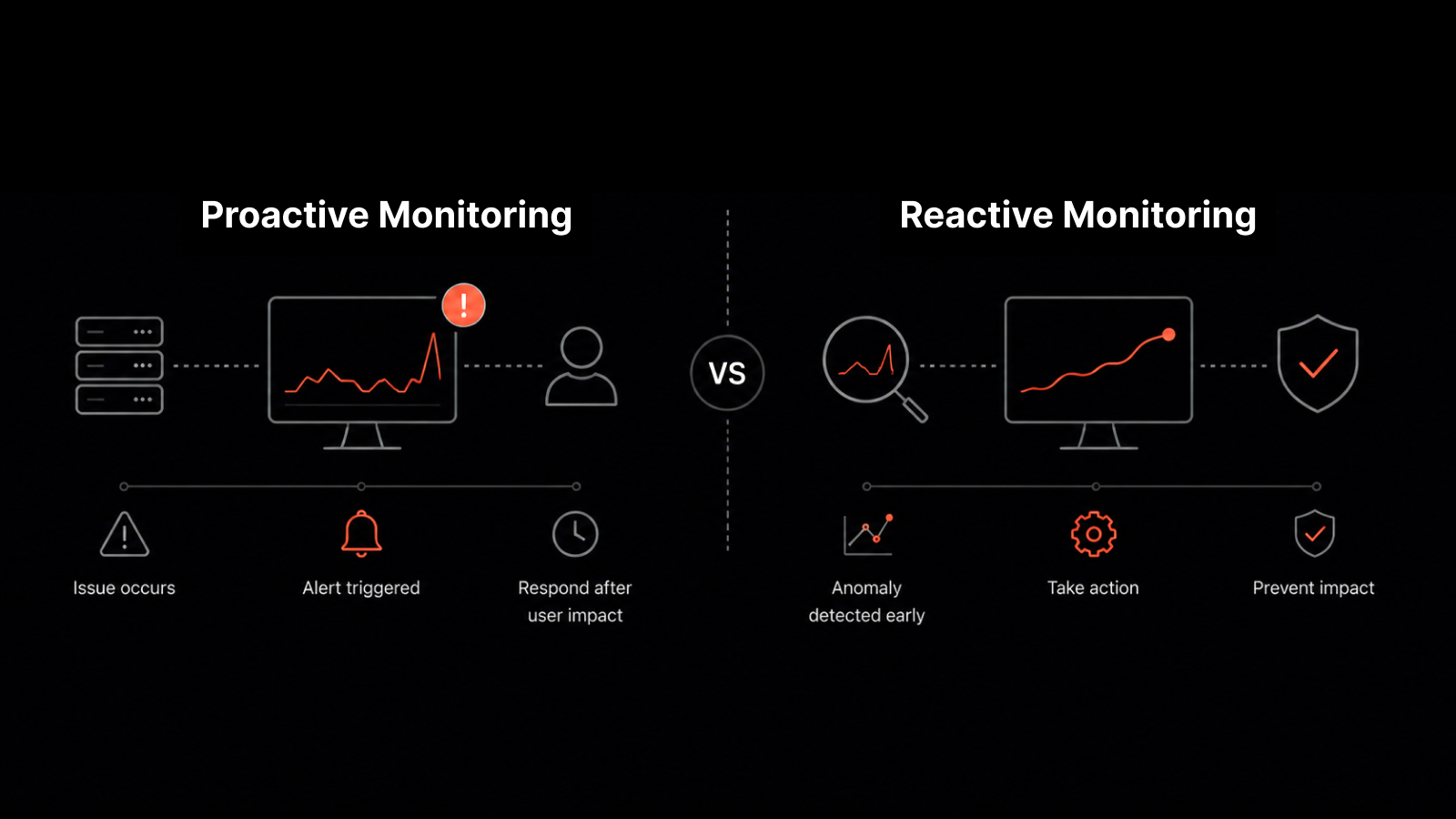
Without NPM, your IT team operates in the dark. They learn about issues when the phone rings, and by that point, the damage is already done. With NPM, they're proactively addressing root causes while users remain unaffected.
2. Achieve Measurable ROI From Day One
IT leaders often struggle to justify monitoring tool investments to finance teams. NPM makes that case straightforward with quantifiable returns:
Reduced MTTR - Root cause analysis capabilities cut troubleshooting time from hours to minutes. When your team isn't manually sifting through logs across 50 devices, they resolve incidents faster.
Recovered productivity -- IT staff spend up to 30% of their time on reactive troubleshooting without proper monitoring tools. NPM gives that time back for strategic projects.
Avoided downtime costs -- Preventing even one major outage per quarter pays for the monitoring platform several times over.
A 2025 EMA (Enterprise Management Associates) study found that organizations with mature NPM practices achieve 3.2x ROI within the first year of deployment. The returns compound as AI models learn your environment and prediction accuracy improves.
3. Spot and Resolve Issues Faster With Root Cause Analysis
When something goes wrong, speed matters. Every minute of troubleshooting is a minute of degraded service. NPM platforms accelerate resolution through:
Real-time network topology visualization that shows exactly where a problem originates, eliminating guesswork.
Correlated alerting that groups related events so your team addresses the root cause rather than chasing symptoms across multiple tickets.
Automated remediation for common issues -- restarting services, clearing caches, or rerouting traffic -- without waiting for human intervention.
The difference is dramatic. Without NPM, troubleshooting a network slowdown might involve logging into a dozen devices, checking interfaces manually, and correlating timestamps across separate log files. With NPM, a single dashboard pinpoints the congested link, the affected services, and the probable cause within seconds.
4. Strengthen Your Cybersecurity Defenses
NPM isn't a replacement for dedicated security tools, but it provides a critical security layer that many organizations overlook. Here's why:
Baseline deviation detection -- NPM establishes what "normal" looks like for your network traffic. When a compromised device starts exfiltrating data at 3 AM, that anomalous pattern triggers an immediate alert.
Unauthorized device detection -- Auto-discovery capabilities identify any new device connecting to your network, flagging rogue access points, shadow IT deployments, or compromised IoT devices.
Traffic analysis - Network traffic analysis reveals unusual data flows that could indicate lateral movement by an attacker or data exfiltration attempts.
Forensic investigation support -- Historical performance data provides the timeline and evidence security teams need during incident investigation.
For organizations that can't justify a full SIEM deployment, NPM provides that essential first layer of network security visibility.
5. Scale Confidently as Your Network Grows
Network infrastructure doesn't stay static. Cloud migrations, IoT deployments, remote work architectures, and digital transformation initiatives continuously expand the attack surface and monitoring requirements.
Modern NPM solutions handle this growth through:
Auto-discovery that continuously identifies new network devices, interfaces, and services as they come online.
Cloud-native monitoring that extends visibility into AWS, Azure, GCP, and multi-cloud environments alongside on-premises infrastructure.
Scalable architecture that handles tens of thousands of monitored objects without performance degradation.
API-driven integration with orchestration platforms (Terraform, Ansible, Kubernetes) for monitoring-as-code in DevOps workflows.
According to IDC's 2025 Network Infrastructure Forecast, the average enterprise network grows by 23% annually in terms of monitored endpoints. An NPM platform that can't scale with that growth becomes a liability rather than an asset.
6. Build the Evidence Base for Infrastructure Upgrades
Every IT leader has faced this challenge: you know a switch, server, or WAN link needs an upgrade, but leadership wants data before approving the budget. NPM provides exactly that evidence:
Historical trend analysis shows how utilization has increased over weeks, months, or quarters -- turning a gut feeling into a data-backed business case.
Capacity forecasting with AI-powered predictive analytics projects when a resource will hit its limits, giving leadership advance notice and planning time.
SLA compliance reports document actual performance against committed service levels, highlighting where infrastructure limitations threaten business commitments.
Comparative analysis benchmarks current infrastructure performance against industry standards and organizational targets.
Instead of walking into a budget meeting with "I think we need a new core switch," you walk in with six months of utilization data showing the device consistently hitting 85% capacity during peak hours, with a forecast crossing 100% within the next quarter.
7. Enable Cross-Team Collaboration and Accountability
Network issues rarely exist in isolation. A database slowdown might stem from network congestion, a storage bottleneck, or an application code change. NPM bridges the gaps between teams:
Shared dashboards give network, server, application, and security teams a common view of infrastructure health, eliminating the finger-pointing that slows down incident response.
ITSM integration automatically creates and routes tickets when monitoring thresholds are breached, with all relevant diagnostic data attached.
ObserveOps platform integration correlates network events with application performance and infrastructure metrics for true end-to-end observability.
Executive dashboards translate technical metrics into business impact summaries that leadership can understand and act on.
How Motadata Transforms Network Performance Monitoring
Motadata delivers AI-native network performance monitoring that goes beyond simple metric collection. Built for hybrid and multi-cloud enterprises, it provides:
AI-powered anomaly detection and predictive analytics that catch issues before they affect users
Automated root cause analysis that reduces MTTR from hours to minutes
Unified visibility across on-premises, cloud, and hybrid infrastructure in a single pane of glass
Auto-discovery of network devices, interfaces, and applications across multi-vendor environments
Smart alerting with noise reduction that surfaces actionable insights instead of overwhelming teams with notifications
Seamless ITSM integration for end-to-end incident lifecycle management
Start your free trial and experience complete network visibility within minutes. Or request a demo to see how Motadata's AI-native platform transforms your monitoring operations.
FAQs
Why is network performance monitoring important for businesses?
NPM is critical because it prevents costly downtime, accelerates issue resolution, and provides visibility into network health. Without it, IT teams react to problems after users are affected, leading to longer outages, higher costs, and degraded customer experience. With NPM, teams proactively identify and resolve issues before they impact business operations.
What is the ROI of network performance monitoring?
Organizations with mature NPM practices typically achieve 3-4x ROI within the first year. Returns come from reduced downtime costs, faster incident resolution (lower MTTR), recovered IT staff productivity, and avoided SLA penalties. A single prevented outage can justify the entire annual cost of an NPM platform.
How does NPM help with cybersecurity?
NPM establishes baseline network behavior and alerts teams when anomalies occur -- such as unusual traffic spikes, unauthorized devices, or suspicious data flows. While it doesn't replace dedicated security tools, it provides a critical first layer of threat detection and supplies forensic evidence for incident investigations.
What's the difference between network monitoring and network performance monitoring?
Network monitoring focuses on availability -- whether devices are up or down. Network performance monitoring goes deeper, measuring latency, jitter, packet loss, bandwidth utilization, and application response times to ensure the network isn't just available but performing optimally for end users.
How does AI improve network performance monitoring?
AI enhances NPM through dynamic baselining (learning what's "normal" for your specific environment), predictive analytics (forecasting failures before they occur), automated root cause analysis (correlating events across devices), and intelligent alerting (reducing noise by grouping related events and suppressing false positives).