What is Cloud Threat Detection? An Ultimate Guide for 2026
What if the next breach in your cloud is already in motion, and your team has no idea how to see it?
Cloud workloads are growing fast. APIs, identities, and data are spread across AWS, Azure, GCP, and on-prem systems all at once. Every layer creates its own logs, its own alerts, and its own blind spots.
Most security teams are short on visibility, context, and time.
That is the gap cloud threat detection is built to close. It studies the activity inside your cloud and flags the moments that do not match normal behavior, often before users feel any impact.
According to IBM's 2024 Cost of a Data Breach Report, the average cost of a cloud-related breach now sits well above 5 million dollars. That kind of risk has pushed cloud threat detection from a "nice to have" to a board-level priority.
In this guide, we will walk through what cloud threat detection is, how it works, the main categories you will hear about, and how to choose the right platform for your team in 2026.
Before we get into how to evaluate a platform, let us start with the basics.
What is Cloud Threat Detection?
Cloud threat detection refers to real-time monitoring of your cloud environment to catch suspicious or malicious activity as it happens.
It looks at what’s going on across your workloads, data, identities, and control plane, and flags anything that does not match normal behavior.
The key difference is this: it focuses on real attacks in progress, not just risks or misconfigurations.
Instead of only checking what could go wrong, it helps you see what is going wrong right now.
In simple terms, it helps you detect:
Someone using stolen credentials to log in
Unexpected activity inside workloads or containers
Abuse of cloud resources, like cryptojacking
Unusual data access or data leaving your environment
Why It Matters in 2026
Cloud attacks are getting smarter and quieter. Instead of breaking in, attackers now log in using valid credentials, which makes them much harder to detect.
According to CrowdStrike, over 75% of cloud attacks involve valid credentials. That means traditional security tools, which look for malware or known patterns, often miss these threats.
There is also growing pressure from regulations like DORA, HIPAA, and Sarbanes-Oxley Act. These require you to detect and respond to threats quickly.
Why this matters for you:
You need to detect activity that looks normal but is risky
You cannot rely only on alerts or static rules anymore
You need faster response to reduce damage and meet compliance
How It Differs from Traditional Security
Traditional security was built for fixed environments. It assumes you have clear boundary, stable systems, and predictable traffic. That is not how the cloud works.
Cloud environments are dynamic, spread out, and heavily driven by APIs. Because of that, detection needs to work differently.
Here’s what changes:
You are not protecting a single perimeter anymore, but many distributed services
Detection is based on behavior, not just signatures or rules
Identity, workload, and network signals are connected, not isolated
Most activity happens through APIs, not just network traffic
This is why logs from tools like AWS CloudTrail and Google Cloud Audit Logs are so important. They show what actions are actually happening inside your cloud.
The shared responsibility model also matters here. Your cloud provider secures the infrastructure, but you are responsible for your workloads, identities, configurations, and data. Cloud threat detection focuses on that part you control.
How Cloud Threat Detection Works
Now that the basics are clear, let’s look at how this actually works in practice. The process is not complicated, but each step plays an important role.
1. Telemetry Collection Across the Cloud Stack
Everything starts with visibility. The system collects data from across your cloud environment so it can see what is happening in real time.
Common data sources include:
Logs from AWS CloudTrail, Azure Activity Logs, and Google Cloud Audit Logs
Activity inside workloads, such as processes, files, and network connections
Identity-related events from IAM, SSO, and identity providers
API and control plane actions
If you do not have this visibility, detection simply will not work. You cannot catch what you cannot see.
2. Behavioral Analytics and Baselining
Once the system has data, it starts learning what “normal” looks like in your environment. This includes how users log in, how services talk to each other, and how workloads behave.
Anything that looks different from this normal pattern is flagged for review.
For example:
A user logging in from a new country
A sudden privilege change
A workload communicating with an unknown service
This step is important because many modern attacks look normal on the surface. Behavior-based detection helps you catch what rules alone would miss.
3. Event Correlation and Threat Context
One alert by itself usually does not mean much. But when you connect multiple signals, you start to see the full picture.
Cloud threat detection platforms link related events together and turn them into a single incident. This gives you context instead of noise.
What you get from this:
A clearer view of what actually happened
Fewer duplicate or low-value alerts
Faster and more accurate investigation
This saves time and helps your team focus on real threats.
4. Real-Time Response and Containment
The final step is taking action. Detecting a threat is useful only if you can respond quickly.
Modern platforms allow you to respond automatically or with minimal manual effort.
Typical response actions include:
Blocking or isolating a compromised workload
Revoking suspicious user access or tokens
Triggering automated response workflows
Sending high-priority alerts to the right team
The goal is simple: reduce the time between detection and response. The faster you act, the less damage an attacker can do.
What is the Difference Between CDR vs CSPM vs CNAPP?
Here is the comparison between CDR vs CSPM vs CNAPP. Let’s understand the differences.
Capability | CSPM | CDR | CNAPP |
Primary Focus | Configuration security and posture management | Active threat detection and response | Unified cloud security platform |
Detection Method | Policy-based scanning, misconfiguration detection | Behavioral analytics, runtime and identity signals | Combines posture, runtime, identity, and workload protection |
Response Capability | Remediation guidance and limited auto-fix | Automated response, containment, SOAR integration | Broad response capabilities across posture and runtime (varies by vendor) |
Scope | Cloud configurations and compliance posture | Runtime threats, identity misuse, and control plane attacks | Configurations, workloads, identities, data, and development pipelines |
Best For | Compliance, visibility, and early-stage cloud security | SOC teams focused on real-time threat detection | Organizations consolidating tools and scaling cloud security |
When to Use Each Approach
The right choice depends on how mature your cloud security program is today.
Choose CSPM when your team is starting out, and your main risks are misconfiguration and compliance gaps.
Choose CDR when you have meaningful cloud workloads, an active SOC, and strict detection and response time goals.
Choose CNAPP when you are ready to consolidate tools, reduce sprawl, and unify posture, workload, and runtime detection in one platform.
Most teams move from CSPM to CDR over time. CNAPP becomes the long-term direction once cloud usage and risk grow large enough to demand unified visibility.
What are the Core Capabilities of Cloud Threat Platform?
Let’s now understand the core key features that one cloud threat detection platform should have.
1. Runtime and Posture-Based Detection
The strongest platforms cover both posture and runtime. Posture-based detection catches misconfigurations and risky settings before they get exploited.
Runtime detection picks up active threats inside your workloads, like unusual process activity, unexpected network connections, or file integrity changes. Together, they give your team coverage across both prevention and response.
If forced to pick one, mature cloud teams should weigh runtime detection heavily, since posture alone cannot catch credential theft or zero-day attacks.
2. Identity and IAM Threat Detection
Identity is now the most common cloud attack path. Often, stolen credentials, privilege escalation, and federated identity abuse all show up in real breaches every week.
A strong platform should:
Detect anomalous logins, including impossible travel and odd MFA behavior.
Flag privilege escalation through chained IAM role assumptions.
Watch service accounts for behavior that drifts from baseline.
Connect identity events across IdP, cloud provider, and SaaS layers.
Platforms that treat identity as just another log source will leave gaps where it matters most.
3. AI-Driven Anomaly Detection
AI-driven detection works well when it is built around your environment. The platform should learn how your workloads behave, then flag patterns that drift from that.
A few things to look for:
Behavioral baselines tuned to your specific environment, not vendor templates.
Clear explanations behind each anomaly, so analysts can act on it.
A mix of rules and ML, since neither approach is enough on its own.
Strong alert-to-incident ratios that reflect real-world results.
A strong AI layer also helps automate response. It can categorize incoming risks, prioritize the ones that match known attacker patterns, and trigger automatic actions for low-complexity threats.
That reduces the load on your security team and shortens the path from detection to containment.
Many vendors also map detections to the MITRE ATT&CK Cloud Matrix, which gives your team a clearer view of how each alert fits into the wider attack chain.
For more on how this works in practice, see our guide on anomaly detection.
4. Alert Quality and Noise Reduction
Alert fatigue is the number one operational failure in cloud security teams. Strong platforms work hard to keep alert volume manageable and improve overall alert fidelity.
Key elements include:
Alert correlation that groups related signals into a single incident.
Context enrichment with asset ownership, criticality, and threat intel.
Prioritization is based on real exploitability and business impact.
Easy tuning that suppresses false positives without creating blind spots.
Teams that struggle with alert fatigue often improve fast after reviewing their alert noise reduction approach alongside their detection setup.
5. Automated Response and SOAR Integration
Detection without response is just monitoring. The platform should be able to act, not only watch.
Look for these response capabilities:
Automated containment actions like isolating workloads or revoking credentials.
SOAR integration to trigger existing runbooks.
Graduated response policies that match action to risk levels.
Two-way SIEM integration for unified investigation.
Good response setups reduce MTTR from hours to minutes for common scenarios.
What are the Common Cloud Threats in Your Detection Strategy?
Knowing what you are defending against makes platform evaluation more concrete. These are the cloud threats every detection strategy should address in 2026.
1. Credential Compromise and IAM Abuse
Attackers prefer to log in rather than break in. Stolen API keys, hijacked session tokens, and misused IAM roles show up in most major cloud breaches today.
A strong detection setup should flag chained role assumptions, unusual privilege use, and odd login activity within minutes, not days.
2. Cryptojacking and Unauthorized Compute Use
Cryptojacking is one of the most common cloud abuse patterns.
Attackers spin up compute resources inside compromised accounts to mine cryptocurrency, often quietly running for weeks before anyone notices.
Behavioral analytics catches this quickly, because the activity rarely matches normal compute provisioning patterns.
3. Data Exfiltration
Cloud breaches often end with data leaving the environment. This may happen through public buckets, unusual API calls, or large transfers to unfamiliar regions.
Cloud threat detection watches these patterns in real time and gives your team a chance to stop it before sensitive data moves.
4. Misconfigured Storage and Exposed Services
Publicly exposed S3 buckets, Azure Blob containers, and GCS buckets remain a common breach path. A wrong setting or a stale lifecycle policy can expose sensitive data quickly.
CSPM catches the misconfiguration. CDR catches the unusual access patterns that follow. Both layers matter.
5. Container and Supply Chain Attacks
Compromised container images, malicious build packages, and tampered IaC templates form a growing threat surface. One bad image can spread across many workloads.
Strong platforms scan images at build time and watch for runtime behavior that does not match what the image is supposed to do.
6. Multi-Cloud Identity Federation Attacks
Federated identity makes life easier for users, but it also widens the blast radius for attackers. A phished Azure token can quietly unlock workloads in Google Cloud or AWS.
Cloud threat detection must connect identity activity across providers, since attackers rarely stay inside one cloud.
How to Evaluate a Cloud Threat Detection Platform
Once you understand cloud threats, the next step is choosing a platform that can actually detect and respond to them in real environments.
1. Detection Coverage and Cloud Stack Visibility
Coverage is the foundation of any detection platform. If the platform cannot see across the full cloud stack, it cannot detect complete attack paths.
A strong platform must provide visibility across four key players:
The control plane (API and management activity)
The data plane (network flows and storage access)
Compute runtime (processes, files, and workload behavior)
The identity plane (authentication and permissions)
These layers together form the full attack surface.
Vendors that focus on only one layer often leave critical gaps. Ask for a clear mapping of detections against the MITRE ATT&CK Cloud Matrix. Platforms that cannot demonstrate this typically rely on shallow or generic detection logic.
2. MTTD, MTTR, and Alert Quality
Performance metrics provide a clearer picture than product demos. You should evaluate how quickly the platform detects threats, how fast it responds, and how clean the alerts are.
Look for measurable benchmarks such as mean time to detect (MTTD) under five minutes for critical threats, and mean time to respond (MTTR) under fifteen minutes for common scenarios.
High-quality platforms also maintain low alert-to-incident ratios, which helps to ensure that most alerts are useful.
If a vendor cannot provide real customer metrics, treat that as a risk indicator. Mature platforms track and optimize these numbers because they directly impact security outcomes.
3. Integration and Deployment Flexibility
A detection platform should integrate into your existing ecosystem without forcing major changes. Seamless connectivity with your current tools is critical for efficient operations.
Look for two-way integrations with platforms such as Splunk, Microsoft Sentinel, and ServiceNow.
The platform should also support flexible deployment models, including agentless, agent-based, and hybrid approaches.
Good integration reduces operational friction and accelerates time to value. Poor integration, on the other hand, creates manual work and slows down your security team.
5 Best Practices for Cloud Threat Detection
The following best practices reflect how modern cloud security teams actually build and run effective detection.
1. Build Visibility Across the Full Cloud Stack
Detection is only as strong as the data behind it. Your platform must collect and correlate signals across identities, workloads, network activity, and control planes. Without this coverage, critical attack paths remain invisible.
Start with continuous asset discovery and inventory. Then ensure telemetry flows from sources such as API activity logs, workload runtime signals, and identity providers. This creates a complete, real-time picture of what exists and how it behaves.
This approach works because attackers move across layers, not within one silo. When visibility is unified, detection becomes accurate, contextual, and far more reliable.
2. Prioritize Behavior-Based Detection
Static rules struggle in dynamic cloud environments. Workloads scale up and down, traffic patterns shift, and attackers continuously evolve their techniques.
Behavior-based detection focuses on how systems normally operate. It identifies deviations such as unusual login patterns, abnormal API usage, or unexpected workload communication. These signals are critical for detecting identity compromises and lateral movement.
This method is effective because it adapts to real usage patterns. It detects threats that signature-based systems often miss, especially low-and-slow or stealthy attacks.
3. Reduce Noise Through Smart Correlation
Single alerts rarely tell the full story. In cloud environments, one attack can generate dozens of low-level signals across different services.
Correlation brings these signals together into a single, high-confidence incident. It enriches alerts with asset context, identity data, and threat intelligence, making them easier to understand and prioritize.
This reduces alert fatigue and improves response efficiency. Security teams can focus on real incidents instead of chasing fragmented or duplicate alerts.
4. Refine Detection Coverage Continuously
Cloud environments are constantly changing. New services are deployed; configurations evolve, and user behavior shifts over time.
Detection logic must be reviewed and tuned regularly. This includes updating thresholds, refining rules, and validating coverage against new attack patterns and architectural changes.
Continuous refinement ensures your detection system stays aligned with your current environment. Without it, detection of quality degrades and blind spots begin to grow.
5. Align Monitoring with the Shared Responsibility Model
In the cloud, security responsibilities are divided. Providers secure the underlying infrastructure, while your team is responsible for workloads, identities, configurations, and data.
Cloud security monitoring should focus on this customer-owned layer. That is where most misconfigurations, identity abuse, and runtime threats originate.
A few practical habits strengthen this approach:
Monitor control plane activity through provider logs such as AWS CloudTrail or Azure Activity Logs
Track workload behavior alongside identity and configuration changes
Prioritize alerts around the assets and services you directly control
This alignment ensures your detection efforts are focused where real risks exist, making your security strategy both practical and effective.
Strengthen Cloud Threat Detection with Motadata
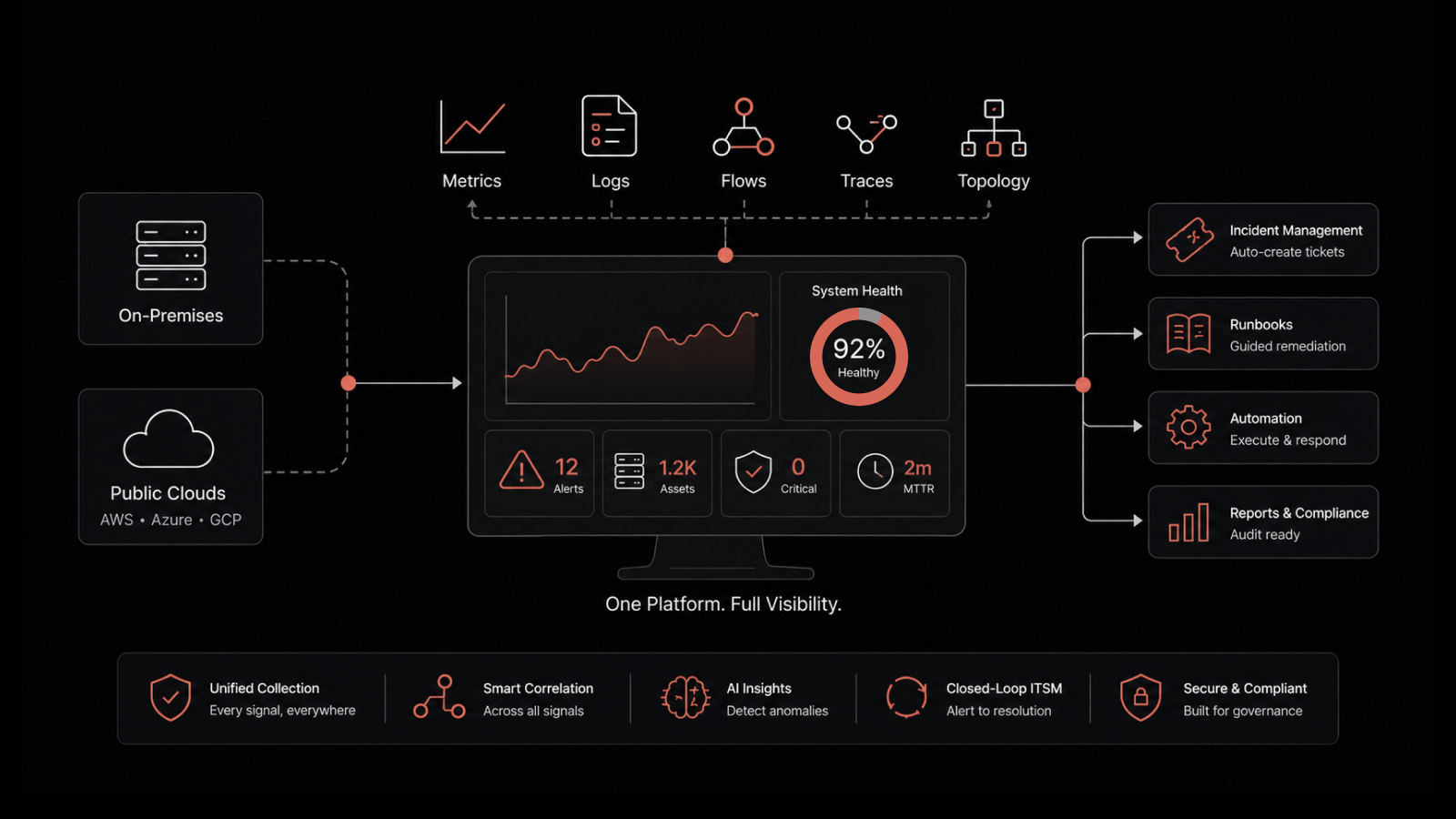
Motadata's AI-native observability platform brings cloud monitoring, anomaly detection, and smart alerting into one place.
That gives your security and IT teams a unified view of what is happening across cloud, hybrid, and on-prem environments.
You get machine learning-based baselines, real-time scoring, and correlation that ties signals across the stack. The result is sharper visibility and fewer low-value alerts.
Here is what teams using Motadata typically gain:
Strong detection across metrics, logs, flows, and traces.
Quick triage with automatic correlation across environments.
Smooth integration with existing ITSM, SIEM, and monitoring tools.
A platform that scales with your environment instead of slowing it down.
If your team is spending more time chasing alerts than catching real threats, Motadata is built for that exact gap.
You can Explore Motadata ObserveOps | Request a Demo
Final Thoughts
Cloud threat detection is not just another security tool. It is what gives your team the chance to catch real threats before they turn into a breach.
The teams that get real value from it tend to follow a few simple habits:
They start with strong visibility across the full cloud stack.
They invest in behavior-based detection, not just static rules.
They focus on alert quality, not alert volume.
They keep refining as their environment evolves.
If your cloud is generating more activity than your team can review by hand, this is a good place to start.
FAQ
What is the difference between cloud detection and cloud threat detection?
Cloud detection is a broader term that covers identifying suspicious or unauthorized activity across cloud environments. Cloud threat detection is more focused, targeting active threats and known attack patterns. In practice, most modern platforms combine both.
How is cloud threat detection different from traditional SIEM?
Traditional SIEM tools were built for fixed perimeters and on-prem logs. Cloud threat detection is built for distributed, ephemeral workloads. It uses behavior baselines, real-time scoring, and cloud-native context that older SIEMs were never designed for.
Can cloud threat detection work in multi-cloud environments?
Yes. Strong platforms support AWS, Azure, GCP, and hybrid setups. The key is making sure detection logic stays consistent across providers, not stronger in one cloud and weaker in another.
How long does it take to implement cloud threat detection?
Initial setup usually takes two to four weeks. Behavioral baselines need another two to six weeks to settle. Full maturity, including automation and team adoption, often takes three to six months.
How does AI improve cloud threat detection accuracy?
AI helps by learning your environment's baseline, adjusting as patterns shift, and connecting signals across sources. This brings down false positives and surface alerts that match real attacker behavior, instead of static rule matches.
Does cloud threat detection replace CSPM or CNAPP?
No. They solve different parts of cloud security. CSPM focuses on posture, cloud threat detection focuses on active threats, and CNAPP brings them together. Most mature setups use a mix that fits the team's size, maturity, and risk profile.
Author
Jagdish Sajnani
Senior Content Strategist
Jagdish Sajnani is a B2B SaaS content strategist and writer. He has experience across different B2B verticals, including enterprise technology domains such as IT Service Management, AI-driven automation, observability, and IT operations. He specializes in translating complex technical systems into structured, engaging, and search-optimized content. His work improves product understanding, strengthens organic visibility, and supports B2B demand generation.