macOS Patch Management for Mixed Windows and Mac Fleets
How many Macs in your environment are running an OS build that your patch compliance report has never counted? In most mixed Windows and Mac deployments, the Windows side is managed by policy and the Mac side is managed by hope. Designers, executives, and engineering leads install updates when a notification interrupts them, and otherwise dismiss the prompt for months.
macOS patch management is the practice of discovering missing operating system and application updates on Apple endpoints, approving them, deploying them on a schedule, and confirming afterward that they installed. The mechanics differ enough from Windows that a process designed around Windows tooling will quietly leave Macs uncovered. That gap surfaces during an audit, or during a CVE response, when nobody can say which Mac is on which build.
This post takes a buyer's view of patch management for macOS instead of a step-by-step install guide. In this blog, you will see why Mac patching behaves differently, what unattended mac patching actually requires, how to bring both platforms into a single compliance report, what to check before committing to a tool, and which five platforms are worth shortlisting.
Why is macOS Patching Handled Differently from Windows?
macOS patching is handled differently from Windows because Apple gives administrators fewer ways to force an update and leaves more of the decision with the person using the Mac. There is no domain-joined policy engine and no internal update distribution point in the way Windows administrators expect. Apple delivers updates to each Mac directly, and the device decides when to apply them within whatever limits your configuration allows.
Four differences drive most of the operational pain:
Update authority: OS updates on Apple silicon need an account holding volume ownership, which is Apple's permission model for approving system-level changes, so a generic service account configured for Windows will fail on a Mac
Install mechanics: The system volume is sealed and cryptographically signed, so an OS update replaces a signed snapshot instead of patching individual files in place
Download weight: Because the update swaps a snapshot, downloads run into gigabytes and a restart is mandatory for every OS update
Application sources: Mac software arrives from the App Store, direct vendor installers, and package managers, so browsers, PDF readers, and Java runtimes each follow a different update path
The practical consequence is that Mac patch coverage depends on credentials, scheduling, and read-back verification working together. Miss any one of them and you record a deployment you cannot prove happened. Windows patching practices can lean on policy enforcement, while mac patch management depends on scheduling and evidence.
The table below compares the two platforms on the points that change how you configure and report on patching.
Behavior | Windows endpoints | macOS endpoints |
Update source | Internal distribution point or vendor catalog | Apple's update service, reached per device |
Authorization to install | Local system or service account | Account with volume ownership on Apple silicon |
OS update size | Cumulative package, often under a gigabyte | Signed system snapshot, several gigabytes |
Restart behavior | Sometimes deferred until next boot | Required for every OS update |
Third-party app coverage | Broad vendor catalogs available | Fragmented across App Store, installers, package managers |
Enforcement model | Policy-driven, largely invisible to the user | Schedule plus deferral limits, visible to the user |
What Breaks When Macs Stay Outside Your Patch Program?
When Macs stay outside your patch program, the damage shows up in three areas: compliance reporting, vulnerability response, and asset accuracy. None of these failures announce themselves. Each one surfaces on the day an auditor or a security team asks a question your reporting cannot answer.
Compliance reporting: A compliance percentage that counts only Windows endpoints looks like a whole-environment figure, and an assessor who finds out it excludes the Macs will discount the entire report
Vulnerability response: When a browser or runtime CVE is published, meaning a known vulnerability with a known fix, Windows remediation takes hours while the Mac fix waits on people reading an email, which breaks the link between vulnerability management and the patch that closes it
Asset accuracy: Macs discovered by an inventory scan but excluded from patch scanning appear as managed devices with no patch state attached to them
Consider a professional services firm running 900 Windows endpoints and 120 Macs. The monthly report shows 97 percent patch compliance, and that figure was calculated across Windows endpoints alone because the Macs were never enrolled for patch scanning. Nothing on the report says so.
There is a second-order cost that rarely reaches a risk register. Every unpatched Mac creates a manual workflow somewhere, usually a service desk technician chasing a user for a restart, and finance often carries a separate Mac tool license to cover the same ground. Those hours and that spend stay invisible until somebody counts them.
What does Unattended macOS Patch Deployment Require?
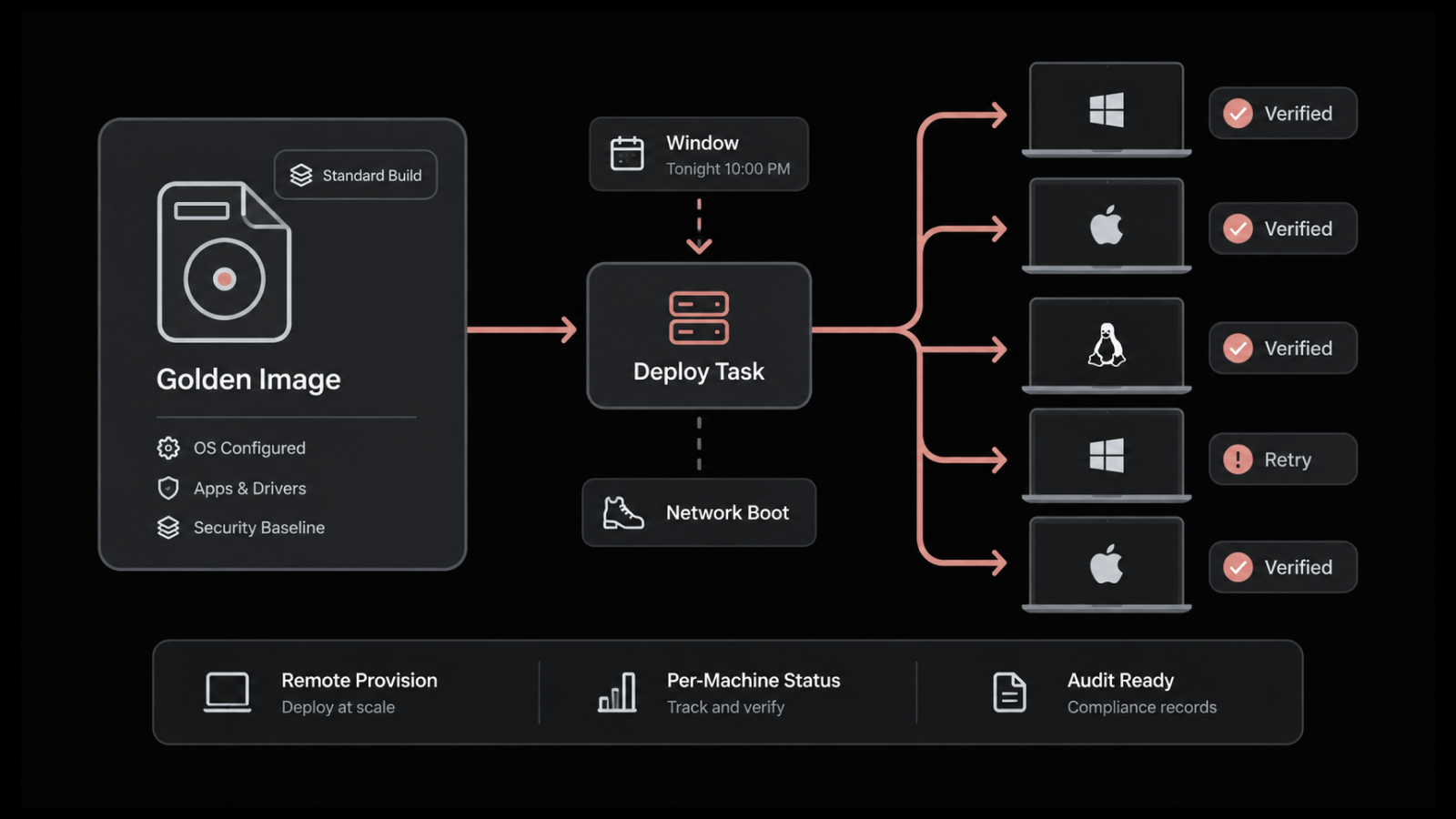
Unattended macOS patch deployment requires four components in place before a single patch moves: an agent on the endpoint, a stored administrator credential that can authorize the install, a deployment policy carrying a maintenance window, and a verification step that reads the installed build back from the device.
Agent coverage: An agent that reports the installed OS build and application versions, so patch discovery has something accurate to compare against
Credential configuration: A stored administrator credential per Mac endpoint, removing the prompt that otherwise stops an overnight run
Deployment policy: A maintenance window, a limit on how many times a user can postpone, and a restart the user is warned about in advance
Read-back verification: A post-install check that records the new build, closing the gap between what was sent and what installed
Credential handling is where most Mac patch automation quietly stalls. A platform that stores an administrator credential against each Mac endpoint can run a scheduled OS patch deployment without anyone entering credentials on the target device, which is the difference between an attended task and an automated one. ServiceOps added credential configuration for macOS endpoints for exactly this reason.
Once all four layers are in place, the next question is whether Mac patch results reach the same report your leadership already reviews.
How do You Keep Mac and Windows Endpoints in One Compliance Report?
You keep Mac and Windows endpoints in one compliance report by collecting inventory through the same agent framework, normalizing patch severity across platforms, and reporting from one dashboard covering every managed operating system. Two consoles produce two numbers, and somebody has to reconcile them manually every month.
Three conditions make a combined report defensible:
Shared inventory: Windows, macOS, and Linux endpoints enrolled through the same discovery and agent workflow, so the denominator in your compliance percentage is complete
Common severity model: Critical, important, and moderate applied the same way on both platforms, so a Mac security update and a Windows one can be prioritized on the same scale
Installed-state reporting: Compliance calculated from what the endpoint confirms it is running, with deployment records used for troubleshooting
Organizations already running Windows patch management alongside Linux patch management usually have the reporting structure in place. Where patch management for macOS runs through the same agent and the same console, as it does for Ubuntu patch management, adding Macs becomes a matter of enrolling endpoints and configuring credentials, and the compliance view widens without a second purchase.
A single figure across every platform is also what makes the tool decision easier to defend to finance and to an auditor.
What Should You Look for in macOS Patch Management Software?
Look for mac patching software that treats macOS as a first-class platform instead of an extension bolted onto a Windows product. The difference becomes visible in the credential model, the licensing, the reporting, and the supported OS releases.
Seven checks worth running during an evaluation:
Current OS support: Confirm the vendor supports the latest macOS major release and states a support timeline for new Apple releases, because a lag of two quarters leaves your newest hardware unmanaged
Credential model: Ask specifically how the tool authorizes an OS install on Apple silicon and whether credentials are stored per endpoint or per group
Unattended scheduling: Verify that a scheduled run completes overnight with no user present, and ask whether enforcement reaches the device through an agent or through Apple's declarative update commands, because the two behave differently when a Mac is asleep or off the network
Deferral and restart control: Look for a configurable deferral count and a forced restart option, since Mac users react badly to unannounced reboots
Unified reporting: Check whether macOS patch state appears in the same compliance report as Windows, or in a separate module with its own export
Test group workflow: Confirm you can deploy to a pilot group and require approval before a fleet-wide rollout
Licensing and consolidation: Check whether macOS coverage is included in the same license as Windows and Linux patching or sold as a separate module, since a second license removes most of the cost case for consolidating
Two questions separate marketing claims from delivered capability in software patch management. Ask the vendor to show a completed Mac deployment report with installed-state verification, and ask which third-party Mac applications the catalog covers by name. A vague answer to either question tells you the capability is thinner than the datasheet suggests.
Top 5 macOS Patch Management Software Options
The five macOS patch management software platforms below were selected on Mac patch coverage, credential handling, unified reporting, and deployment choice. Ratings come from G2 and Capterra where a listing exists. Published prices were read from each vendor's own pricing page with the billing basis stated, and quote-based vendors are marked as such. Vendors change rates without notice, so confirm current figures before you budget.
Several of these platforms are Apple-only or cloud-only by design. That suits organizations built the same way and rules them out for anyone with a data residency mandate or a large Windows footprint.
Platform | Best for | Platforms covered | Deployment | Pricing model |
Motadata ServiceOps | Mixed fleets that also want service desk and assets in one place | Windows, macOS, Linux | On-premises, cloud, private cloud | Quote-based |
Jamf Pro | Apple-only environments needing deep macOS control | macOS, iOS, iPadOS, tvOS | Cloud | Per device, annual |
Action1 | Smaller fleets under 200 endpoints | Windows, macOS | Cloud | Free tier, then quote |
N-able N-central | Service providers managing Macs across client environments | Windows, macOS, Linux | On-premises, cloud | Quote-based |
ManageEngine Endpoint Central | Buyers who want published list pricing | Windows, macOS, Linux | On-premises, cloud | Per endpoint tier |
1. Motadata ServiceOps
Best for: Mixed Windows and Mac environments that want patching, assets, and the service desk on one platform
Rating:
G2: 4.6/5
Capterra: 4.6/5
Disclosure first: ServiceOps is our platform, so read the cons with that in mind.
One agent discovers missing OS and application patches across Windows, macOS, and Linux, and every platform resolves into a single compliance percentage. Credentials stored per Mac endpoint let scheduled OS deployments finish with nobody at the keyboard. Deployment runs on-premises, in the cloud, or in a private cloud.
Pros
- Mac, Windows, and Linux patch state resolve into one compliance figure
- Credential handling built specifically for unattended Mac runs
- Deployment choice covers environments where patch data cannot leave your own infrastructure
- Patching, asset management, and service desk licensed on one platform
Cons
- The third-party application catalog is broader on Windows than on macOS
- Pricing is quote-based, so there is no public per-endpoint rate to compare against
- Apple-only organizations get less from a cross-platform design than a mixed fleet does
Pricing:
Licensing: Quote-based, scoped to modules, endpoint count, and deployment mode
Billing basis: Negotiated on volume, modules, and contract term
Trial: A free trial is available
2. Jamf Pro
Best for: Apple-only environments that need granular macOS control
Rating:
Capterra: 4.7/5
Jamf is the Apple specialist here, and its macOS depth runs ahead of the cross-platform products. Update enforcement, app distribution, and self-service are built around Apple's own management framework.
The trade-off is scope. Windows and Linux stay in a second tool, which leaves a mixed environment with two consoles and two compliance figures.
Pros
- The deepest macOS control available in the category
- New Apple releases are supported quickly
- Self-service model works well with Mac user expectations
- Strong fit for design, education, and Apple-first organizations
Cons
- Apple devices only, so Windows and Linux need separate tooling
- The Mac plan bundles security and identity modules some buyers will not use
- The bundled plan is available to cloud customers only
- A 25-device minimum applies
Pricing:
Jamf for Mac: $12.50 per macOS device, per month, billed annually
Bundle contents: Jamf Pro, Jamf Connect, and Jamf Protect
Minimum: 25 devices
Deployment: Bundled plans are cloud only
Trial: 14 days
3. Action1
Best for: Smaller mixed fleets that stay under 200 endpoints
Rating:
G2: 4.9/5
Capterra: 4.9/5
Action1 patches Windows and macOS endpoints from the cloud, with staged rollouts and automated policies. The free tier covering the first 200 endpoints is the most generous entry point in this list.
Cloud-only delivery removes the infrastructure work. It also rules the platform out wherever patch data has to stay on your own network.
Pros
- Free for the first 200 endpoints with no feature restrictions
- Fast to stand up, with no server infrastructure to build
- Strong reporting for the price point
- Suits distributed workforces with no VPN dependency
Cons
- Cloud only, which rules it out under data residency mandates
- Above 200 endpoints, pricing moves to quote with a mandatory support subscription
- The support fee is not published, so total cost is hard to model in advance
- macOS coverage is narrower than the Windows side
Pricing:
Free tier: First 200 endpoints, no feature restrictions
Above 200 endpoints: Quote-based, including a mandatory support subscription
Billing basis: Annual standard, monthly available for partners
Trial: The free tier acts as the trial
4. N-able N-central
Best for: Service providers patching Macs across multiple client environments
Rating:
G2: 4.4/5
Capterra: 4.2/5
N-central handles Mac patching inside a broader remote monitoring and management platform, on cloud or on-premises. Multi-tenancy is the differentiator, with patch policies applied per client environment.
A single-organization IT function pays for capability it will never use, because the licensing and setup are built for service delivery across many customers.
Pros
- Multi-tenancy suits managed service delivery
- On-premises deployment available
- Patching arrives alongside broader remote management capability
- Mature platform with a long track record
Cons
- Pricing is quote-only, with no published rate card
- The feature set exceeds what a single-organization IT function needs
- Setup and onboarding take longer than cloud-native alternatives
- Mac depth trails the Apple specialists
Pricing:
Licensing: Quote-based, varying by device count, modules, and contract length
Billing basis: Negotiated per device
Trial: A free trial is available
5. ManageEngine Endpoint Central
Best for: Buyers who want published list pricing and a wide third-party application catalog
Rating:
G2: 4.5/5
Capterra: 4.6/5
Endpoint Central patches Windows, macOS, and Linux from one console and carries one of the larger third-party catalogs in the category.
Budgeting is the complicated part. Patch capability spans four editions, and several features are sold as add-ons with their own price tables.
Pros
- Published list pricing, which is uncommon in this category
- On-premises and cloud deployment both supported
- Free edition covers very small environments
- Wide third-party catalog reduces the number of unmanaged applications
Cons
- Every technician beyond the first is chargeable
- Add-ons including EDR and OS Deployment carry their own price tables
- Perpetual licenses carry annual maintenance at 20 percent of the invoice total
- Servers are licensed separately from workstations
Pricing:
Professional edition, 100 workstations, one technician: $1,445 per year on-premises
Same tier on cloud: $1,895 per year
Billing basis: Per endpoint tier, billed annually; perpetual licensing available on-premises
Free edition: Up to 25 endpoints
Trial: 30 days
Bring Mac Endpoints Into One Patch Program with Motadata ServiceOps
Most patch tooling was built for Windows and extended outward, which is why macOS support across the category is thinner than the marketing suggests, particularly for third-party Mac application coverage. That limitation is worth naming plainly during any evaluation. The restart requirement also remains, because no vendor can remove the reboot Apple builds into every OS update.
What a buyer can change is whether Mac patching runs on a schedule with evidence behind it. Motadata ServiceOps brings macOS discovery, credential-backed unattended deployment, and installed-state compliance reporting into the same patch management software already covering your Windows and Linux endpoints. One console, one compliance percentage, one answer when somebody asks how current the fleet is.
FAQs
What is macOS patch management?
macOS patch management is the process of discovering missing operating system and application updates on Mac endpoints, approving them, deploying them on a schedule, and verifying the installed result. It covers both Apple OS updates and third-party application versions across managed devices.
Can Mac patches be deployed without a user present?
Yes, provided an administrator credential is stored for the endpoint and a deployment policy defines the maintenance window. Without a stored credential, the install stops at an authorization prompt and the scheduled run records a failure.
Why do macOS updates require a restart every time?
Apple ships OS updates as a signed system snapshot instead of a set of individual file patches. The device applies the new snapshot at boot, so a restart is part of the install process and cannot be deferred indefinitely.
Can Windows and Mac endpoints appear in the same patch compliance report?
Yes, when both platforms are enrolled through the same agent and discovery workflow and severity is normalized across them. Motadata ServiceOps reports patch state for Windows, macOS, and Linux endpoints in one dashboard with a shared compliance percentage.
Does Motadata ServiceOps support the latest macOS release?
Yes, patch management support covers the current macOS major release alongside Windows and multiple Linux distributions. Support for new Apple releases is added through the standard agent-based patch scanning and deployment workflow.
Author
Poonam Lalani
Content Strategist
Poonam Lalani is a B2B content strategist and writer with a background in computer engineering and experience across enterprise technology domains, including AI, cloud, DevOps, data engineering, and IT operations. She specializes in creating research-driven content that simplifies complex ideas and supports product education, thought leadership, and business growth.