How ITSM Supports Digital Transformation in Large Organizations
Why do digital transformation projects clear every milestone and still leave the service desk working the way it did five years ago? ITSM digital transformation is the part that usually gets skipped, and it decides whether the new technology holds up once it reaches production.
A retail business migrates point-of-sale to the cloud, on schedule and under budget. Two weeks later store managers are calling about card readers timing out, the configuration records still list the old servers, and nobody can say which change caused what. The technology moved while the operating model underneath it stayed exactly where it was.
IT service management transformation is the work of updating that operating model so it can absorb the change. It covers how changes get approved, how configuration data stays accurate, how incidents get routed, and how people find help with services they have never used before. How far you get depends heavily on where your ITSM maturity starts.
This guide covers the six practices that carry a transformation, how maturity changes the outcome, the metrics worth tracking, and the order to fix things in.
What is ITSM Digital Transformation?
ITSM digital transformation is the redesign of how IT service management operates so it can keep pace with the digital services a business is launching. It changes the processes behind approvals, configuration data, request handling, and support, so that new technology reaches users in a state they can actually use.
That definition rests on two terms:
IT service management: The practice of designing, delivering, and supporting IT services across their full life
Digital transformation: The shift of business operations onto digital platforms, usually meaning new applications, new infrastructure, and new ways for people to work
Both are often confused with ITIL, the framework most large organizations use as their reference model. Our breakdown of ITSM vs ITIL covers where one ends and the other begins.
Service management is where those two intersect in practice. Every new application arrives with:
Requests nobody has handled before
Incidents nobody has a runbook for
Configuration items nobody has recorded
Without a service management layer updated alongside the technology, the support model cannot absorb the volume.
Organization size magnifies the effect: Running this at scale usually means a formal ITSM system rather than a shared inbox. A change that would cause mild confusion in a fifty-person business creates thousands of tickets across eleven countries, and the cost of getting it wrong scales with headcount.
Why do Digital Transformation Initiatives Fail at the Operational Layer?
Digital transformation initiatives fail at the operational layer because investment concentrates on new capability while the processes that operate it remain unchanged. Gartner forecasts worldwide IT spending to reach $6.37 trillion in 2026, up 14.2% on the previous year, with the largest increases concentrated in data center systems and cloud services.
Very little of that spending reaches the layer that decides whether the new systems can actually be supported. The underfunded pieces are consistent across organizations:
Approval workflows: The controls that let changes reach production without disrupting live services
Configuration records: The data describing what the new systems run on and what depends on them
Knowledge articles: The documentation that lets anyone support a new service from its first week
Budget the operational layer at the same time as the platform, rather than after it goes live.
The result is a widening gap between what the business has bought and what IT can actually operate, and it is the same gap that causes traditional ITSM to buckle as an organization grows. That gap becomes measurable in outage costs. Uptime Institute's 2026 annual outage analysis reports that 57% of survey respondents said their most recent major outage cost more than $100,000, and one in five put the figure above $1 million.
Most of those failures trace back to something a mature service management practice would have caught:
A change that went in without a record
A configuration entry nobody refreshed
A dependency known to a single engineer
Which ITSM Practices Support Digital Transformation?
Six ITSM practices do most of the work in supporting a digital transformation. The rest matter, but these are the ones that fail first when a large organization changes its technology faster than it changes its processes.
1. Change Enablement: Getting New Technology Into Production Safely
Change enablement decides whether new technology reaches production without disrupting what already runs there. Change volume rises sharply during a transformation, which is when a heavy approval process becomes a constraint on delivery.
Tiering is the practical answer:
Standard changes: Pre-approved against a known risk profile and deployed on a schedule
Normal changes: Routed through review before deployment
Emergency changes: Reserved for genuine incidents and escalated to a full board
Getting the tiers right is the single highest-value adjustment in most change management practices.
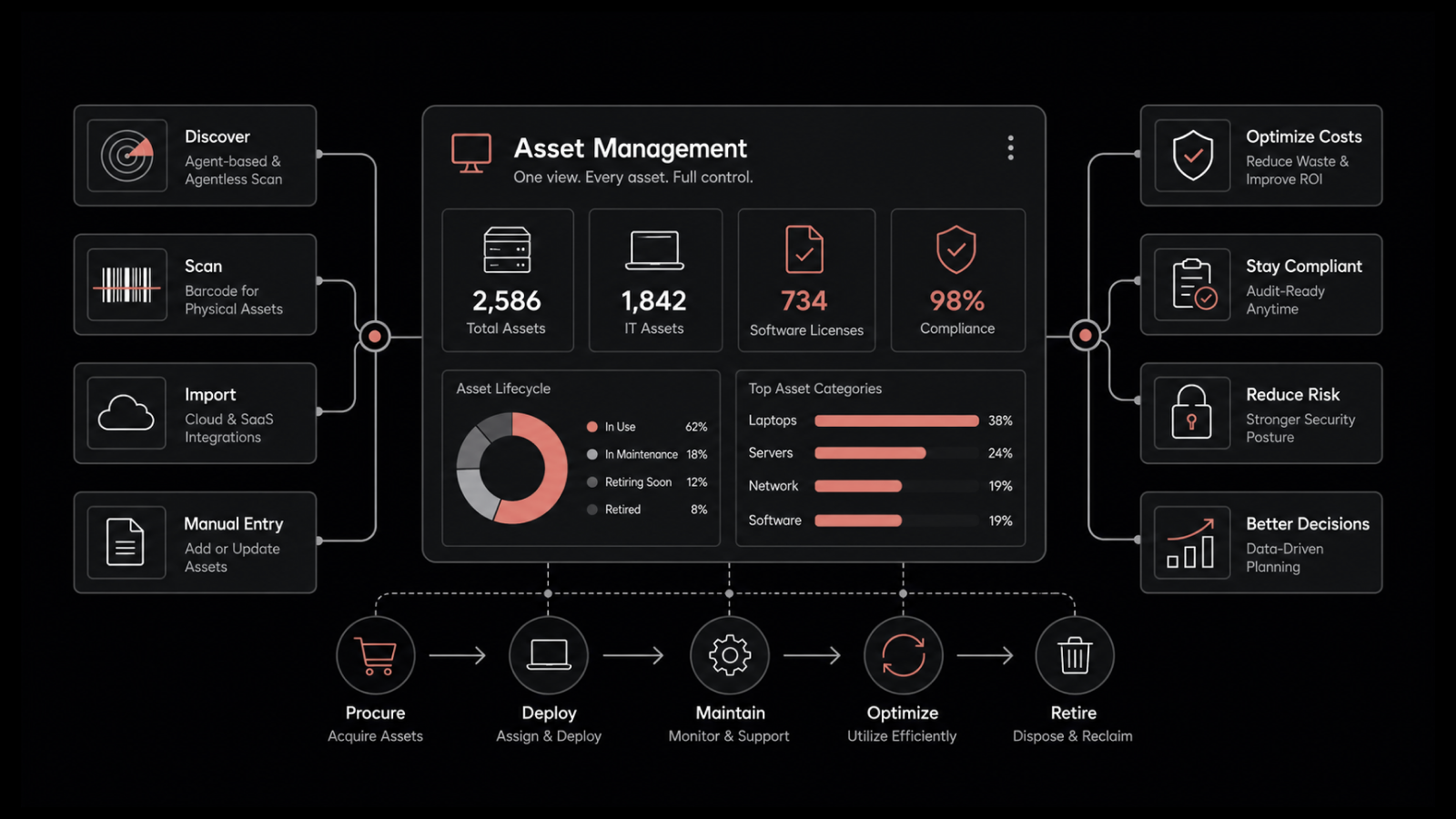
2. Configuration and Asset Records: Knowing What a Change Will Affect
Configuration data is what allows anyone to determine what a change actually affected. When a transformation moves workloads between platforms, records written for the old architecture become inaccurate within weeks.
A working CMDB depends on:
Automated discovery: Records that refresh from the environment rather than from a manual update cycle
Relationship mapping: A proposed change to one server showing every service that depends on it before approval
Without both, change approval relies on assumption rather than record.
3. Incident and Problem Management: Handling Failures on Unfamiliar Systems
Incident management restores service quickly. Problem management stops the same failure from returning by resolving the underlying cause. Both come under pressure at once during a transformation, because new systems generate unfamiliar failure modes at higher volume.
Routing needs attention first:
Categories: New services given their own rather than being absorbed into an existing queue
Assignment rules: Tickets reaching the group that actually knows the new platform
Escalation paths: Defined from day one rather than improvised during the first major incident
Without that, tickets pass between groups repeatedly and resolution times rise across every category.
4. Service Catalog and Request Fulfillment: Making New Services Requestable
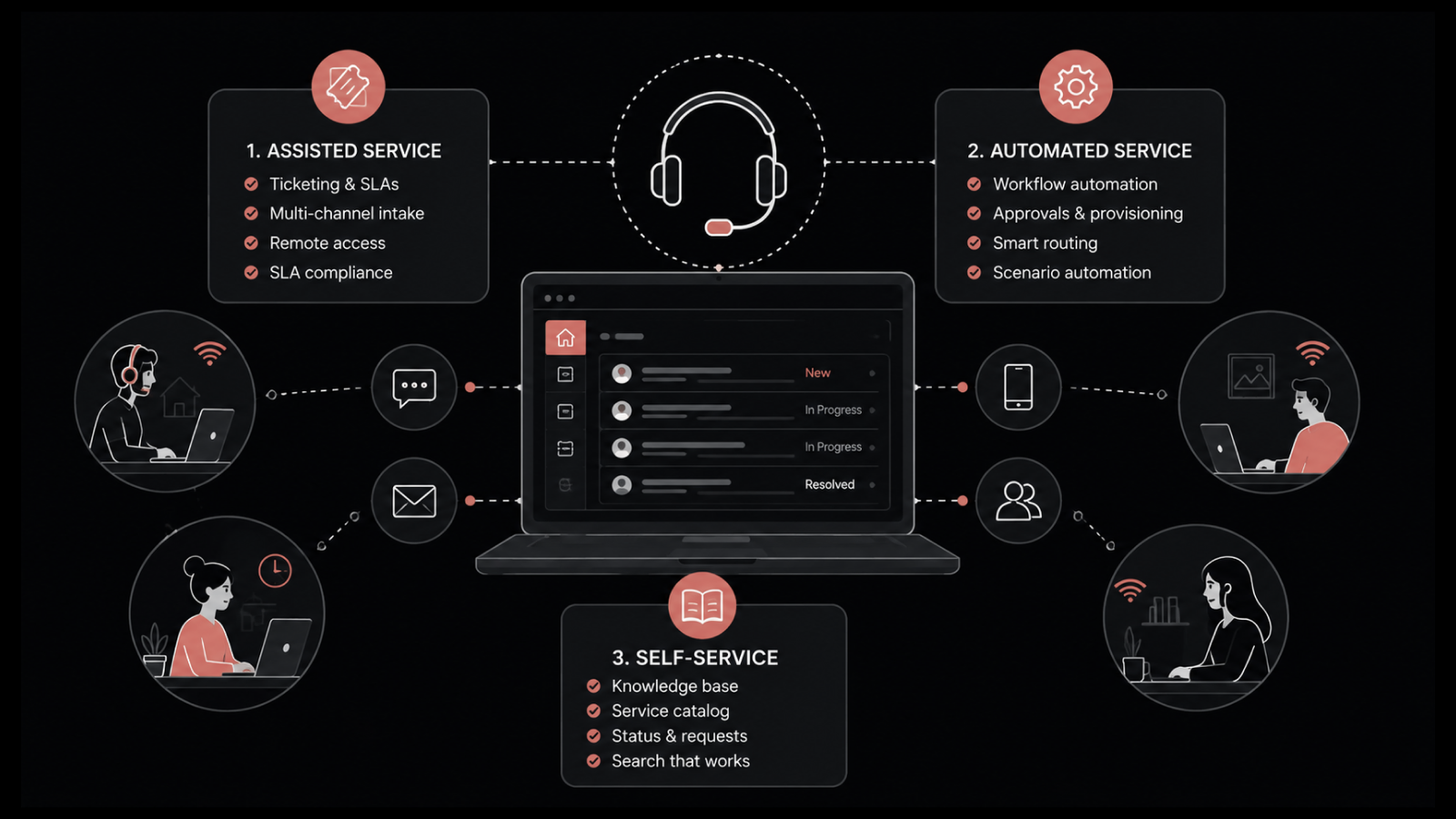
The service catalog is where employees encounter the transformation directly. Every new application creates access requests, provisioning tasks, and license assignments that somebody has to handle.
Publishing those as catalog items converts unmanaged email traffic into a measurable queue. Each item needs:
An owner: The group accountable for delivering the request
An approval path: Who signs off, and at what threshold
A service level: The wait time the requester can expect, set by the service level agreement
Digital workplace initiatives depend heavily on this. When employees cannot navigate the catalog, the request volume goes straight back to the service desk. The same structure extends past IT into HR, finance, and facilities, which is where enterprise service management begins.
5. Knowledge Management: Scaling Support Beyond a Few Experts
Knowledge management determines whether support scales with the transformation or concentrates on the few people who understand the new systems. New applications arrive without any institutional knowledge behind them.
The discipline that works is capturing articles as part of resolving tickets rather than as a separate documentation project. That produces:
Coverage that keeps pace: Articles written while the detail is fresh, by the person who solved the ticket
Self-service that holds up: Requests answered before they reach an agent
Strong knowledge management is the only realistic way to absorb a large increase in request volume without adding headcount.
6. Workflow Automation: Absorbing the Volume a Transformation Creates
Automation handles the repetitive work that a transformation multiplies. Onboarding, access provisioning, password resets, and standard change deployment all scale poorly when handled manually.
Mapping the existing ITSM workflows comes first, because automating an undefined process only makes the disorder faster. Start with the highest-volume, lowest-judgment work:
Onboarding and offboarding: Account creation, group membership, and hardware assignment
Access requests: Standard entitlements granted against a defined approval rule
Standard change deployment: Pre-approved changes released on a schedule
Most organizations find that a small number of request types account for the majority of ticket volume, which gives service desk automation a short payback period once the catalog is in place.
What Are Common ITSM Transformation Examples?
Common ITSM transformation examples fall into three recognizable patterns, depending on what triggered the work.
Consolidation after growth: An organization that has acquired several businesses operates four separate service desks, four catalogs, and no shared view of assets. The transformation work is merging those onto one platform with a single CMDB, which usually surfaces years of duplicate licenses and untracked hardware in the process. Consolidation of this kind depends on IT asset management reaching the same platform as the service desk.
Support redesign for a cloud migration: Infrastructure moves to cloud platforms and the existing support model, built around on-premises systems and physical access, no longer matches the environment. Categories, assignment groups, and escalation paths all get rewritten. Monitoring is connected to the service desk so alerts open tickets automatically, which is the most common form of ITSM integration during a migration.
Self-service buildout under headcount pressure: Request volume grows faster than the service desk can hire. The work centers on the catalog and the knowledge base, moving common requests to guided self-service so that the volume reaching agents falls even as total demand rises.
How does ITSM Maturity Affect Digital Transformation?
ITSM maturity affects a digital transformation because the change inherits whatever process discipline already exists. An organization with accurate configuration data and a working change process absorbs new technology reasonably well. Where those foundations are missing, the transformation amplifies the process gaps that already existed.
Maturity generally moves through five recognizable stages, and each one changes what a transformation can realistically achieve.
The five stages:
Ad hoc: Support happens through email and personal relationships, with no consistent record of what was done
Repeatable: Tickets get logged and categories exist, though quality depends on who is on shift
Defined: Processes are documented, service levels are agreed, and configuration records exist
Managed: Performance is measured against targets and the data is used to make decisions
Optimized: Improvement is continuous, automation is widespread, and problem management prevents recurring failures
Moving between the middle stages is largely a question of adoption rather than tooling, which is covered in our guide to ITIL implementation.
Most large organizations attempting a transformation fall somewhere between defined and managed. Moving up a stage is a deliberate exercise, and it belongs in the ITSM strategy rather than in the transformation plan itself. An accurate assessment matters, because launching a major technology change from stage one leaves the support function overwhelmed rather than improved.
Which Metrics Show an ITSM Transformation is Working?
The metrics that show an ITSM transformation is working all measure the state of support after the change. Six are worth watching from the moment the first new service goes live.
Mean time to resolve: Should fall or hold steady as new services come online
First contact resolution: Rising numbers indicate knowledge and routing are keeping pace
Self-service resolution rate: The clearest signal that the catalog and knowledge base are landing
Change success rate: Failed changes during a transformation point directly at weak configuration data
Ticket volume per new service: A spike that does not settle within a few weeks means the support model was never updated
Employee satisfaction with IT: The measure executives will use to judge the transformation
Baseline every one of these at least a quarter before the first new service goes live. A transformation measured only after the fact has no comparison point, which is how projects end up declared successful on the strength of the go-live date alone.
Read the six together rather than individually, because the interesting signal is usually in the combination. A falling mean time to resolve alongside a rising ticket volume per new service means agents are getting faster at handling a problem that should have been designed out. A rising self-service rate with flat first contact resolution points at a knowledge base that answers easy questions and nothing else.
A fuller breakdown of what to measure and what good looks like is covered in our guide to service desk metrics.
Where Should an ITSM Transformation Start?
An ITSM transformation should start with the configuration data, because every other decision depends on knowing what is actually deployed. Five steps cover most of what a large organization needs in place before a major technology change goes live.
Audit the configuration data: Establish what you actually have and how accurate the records are, since every other decision rests on this
Tier the change process: Separate standard, normal, and emergency changes so approval speed matches risk
Rebuild the service catalog: Publish the new services with owners, approval paths, and service levels before users start requesting them
Capture knowledge as you go: Require an article or an update on every novel ticket resolution rather than scheduling documentation later
Automate the top five request types: Take the highest-volume, lowest-judgment work out of the queue once the catalog is stable
Doing these in reverse order is a common and expensive mistake. Automating a broken process, or publishing a catalog on top of inaccurate configuration data, embeds the problem rather than resolving it. Several other implementation pitfalls are worth reading before you commit to a sequence.
When does ITSM Slow a Transformation Down?
ITSM slows a transformation down when governance becomes an end in itself. This is more common than most vendors acknowledge.
A change advisory board that meets weekly and reviews every deployment will stall a modernization effort. So will a catalog with fourteen approval steps, or a configuration database so detailed that keeping it current consumes more effort than it returns.
This pattern shows up across current ITSM trends, where governance grows faster than the delivery it is meant to protect.
The failure mode is treating governance as a goal rather than a means of managing risk. If a control cannot be traced back to a specific risk it reduces, it is overhead. Reviewing that properly, and removing what fails the test, is part of the transformation work.
Run Your ITSM Digital Transformation on Motadata ServiceOps
Motadata ServiceOps covers the six practices in a single platform, so change records, configuration data, catalog items, and knowledge articles reference each other rather than living in separate systems. Change requests show the affected configuration items before approval. Asset data and service desk tickets share one database.
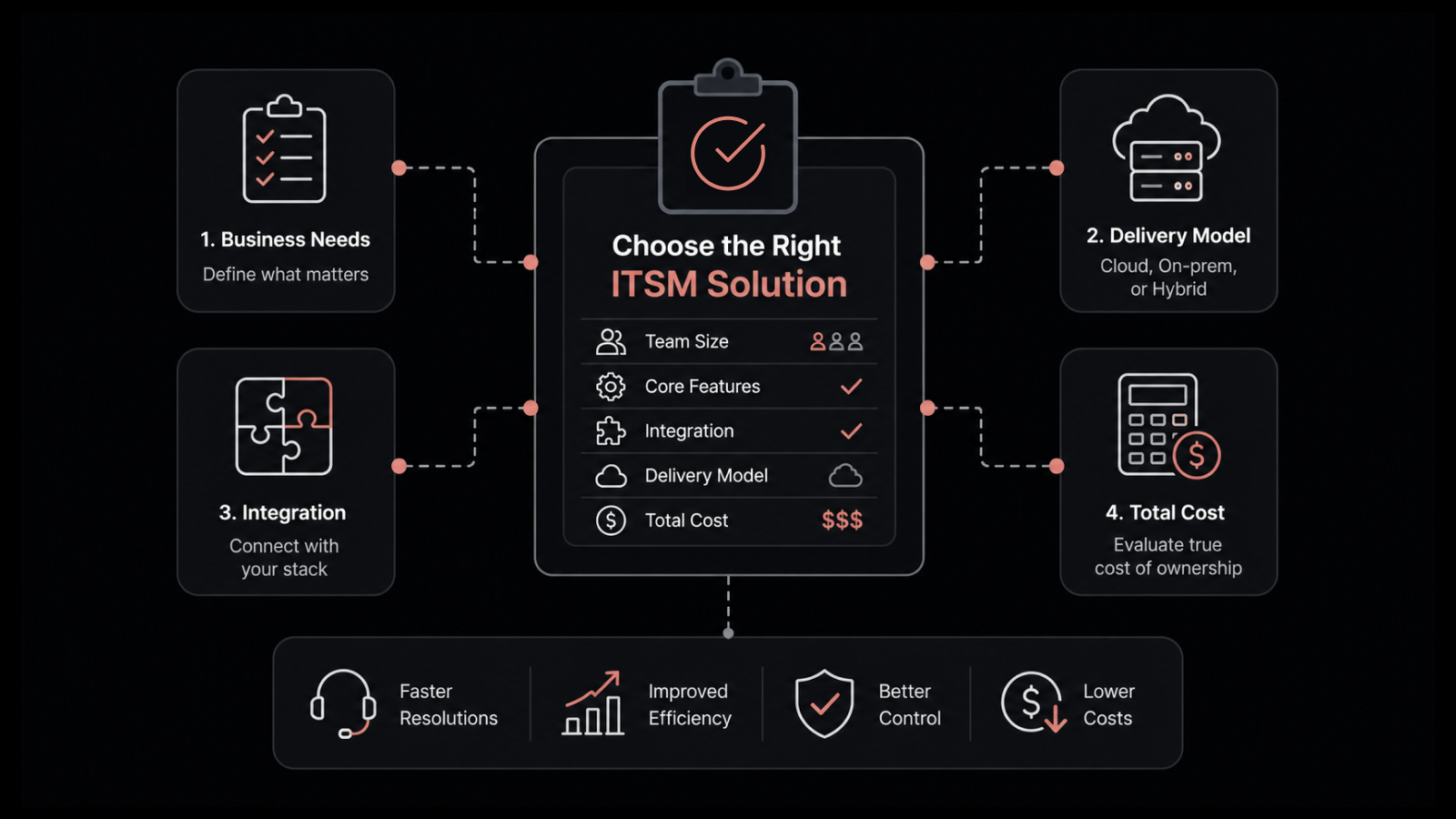
The platform is PeopleCert ATV assessed across twelve ITIL 4 practices, and licensing is per module, so a large organization can start with the service desk and add asset or patch management as the transformation progresses. That modular structure is what separates the better ITSM solutions for digital transformation from a single fixed suite.
That structure matters most in exactly the situation this guide describes, where a transformation is already underway and the support model has to catch up without a two-year replatforming project of its own.
FAQs
What is ITSM transformation?
ITSM transformation is the redesign of IT service management processes so they can support new digital services. It covers change approval, configuration records, request handling, knowledge, and automation. The goal is a support model that scales with the technology the business is adopting.
What are the 5 stages of ITSM maturity?
The five stages are ad hoc, repeatable, defined, managed, and optimized. Organizations move from inconsistent, undocumented support toward measured processes with widespread automation and continuous improvement. Most large enterprises attempting a transformation are somewhere between defined and managed.
What is digital transformation in ITIL?
ITIL 4 treats digital transformation as an organizational shift that service management supports rather than owns. Its guiding principles, particularly starting where you are and progressing iteratively, are designed for exactly this situation. The practices supply the operational structure the change runs on.
What is the difference between ITSM and ITIL?
ITSM is the practice of managing IT services. ITIL is a framework offering guidance on how to do that well. You can run ITSM without ITIL, but most large organizations use ITIL as the reference model because it gives shared vocabulary across distributed groups.
How does ITSM support digital transformation in large organizations?
ITSM supplies the operating model that makes new technology supportable at scale. It governs how changes reach production, keeps configuration records accurate, routes incidents on unfamiliar systems, and publishes new services in a catalog people can use without calling for help.
Author
Poonam Lalani
Content Strategist
Poonam Lalani is a B2B content strategist and writer with a background in computer engineering and experience across enterprise technology domains, including AI, cloud, DevOps, data engineering, and IT operations. She specializes in creating research-driven content that simplifies complex ideas and supports product education, thought leadership, and business growth.