How the Vulnerability Management Lifecycle Runs from Discovery to Verified Fix
Who in your organization can say, without opening three separate systems, whether last month's critical findings are actually closed? A deployment record answers half of that. The other half needs a rescan, and the rescan often never happens.
The vulnerability management lifecycle is that question written down as a repeatable process. It runs from knowing what you own through to proving a fix landed, and it restarts the moment it closes. Every organization already performs some version of it, whether or not anyone has drawn it.
Very little of that delay comes from the scan itself. Detection is automated almost everywhere now, while the work after detection crosses owners, approval queues, and maintenance windows. That distance is also why patch management and vulnerability management get treated as the same discipline when they are two halves of one loop.
In this blog, you will see each of the five stages defined, along with who owns it, what triggers it, and what it has to produce before the next stage can start. You will also see the remediation timelines regulators now expect, the metrics that show whether the loop is closing, and the handoff points that create most of the delay.
What is the Vulnerability Management Lifecycle?
The vulnerability management lifecycle is a continuous process for finding security weaknesses across your infrastructure, ranking them by risk, fixing or mitigating them, and confirming the fix held. The work forms a loop, because new flaws are published daily and your software inventory changes every week.
NIST describes enterprise patch management in almost the same shape, calling it the process of identifying, prioritizing, acquiring, installing, and verifying the installation of patches and updates across an organization, set out in SP 800-40 Revision 4. That framing matters for one reason. Verification belongs inside the process, and a program that stops at deployment has only completed four fifths of the work.
The distinction worth holding on to:
Vulnerability assessment: A point-in-time exercise that identifies and scores weaknesses, producing a picture of the environment on the day it ran
Vulnerability lifecycle management: The standing operational process that acts on those findings, tracks them to closure, and repeats on a defined cadence
Assessment answers what is wrong. The lifecycle answers what happened next, which is the part auditors and boards ask about.
What are the Benefits of a Structured Vulnerability Management Lifecycle?
The benefits of a structured vulnerability management lifecycle come from repeatability, because the same work happens in the same order and produces the same evidence every cycle. Fixing findings as they arrive clears individual tickets. A defined loop lowers exposure across the whole environment and leaves a record behind.
Five outcomes follow a documented lifecycle:
Shorter exposure windows: Event-driven detection and assigned due dates cut the time between public disclosure and a verified fix
Defensible prioritization: Ranking that combines exploit status, exposure, and business context gives you a reason for every deferral, which matters once IT risk management comes under board scrutiny
Audit evidence on demand: Timestamped scan, approval, and closure records answer auditor questions without anyone reconstructing history
Predictable maintenance load: Batching findings by patch and severity turns unplanned emergency work into scheduled deployment windows
Cleaner incident response: An accurate inventory and a current finding list answer the first question every incident raises, which is where the affected software is running
None of these depend on buying a different scanner. They follow from naming owners, attaching due dates, and confirming closure.
Why does the Vulnerability Management Process Stall Between Stages?
The vulnerability management process stalls because each stage has a different owner, a different tool, and a different clock. Detection belongs to security, remediation belongs to IT operations, and the queue between them is where the days accumulate.
The 2026 Verizon Data Breach Investigations Report put numbers against that gap:
Exploitation became the leading initial access vector: 31% of breaches, up from 20% the previous year
Full remediation of known exploited flaws fell: 26% closed, down from 38%
Median time to full resolution stretched: 43 days, up from 32
Volume climbed alongside both: A median of 16 known exploited vulnerabilities per organization, up from 11
One number in that report matters more than the others. Verizon observed that 60% to 70% of known exploited vulnerabilities remained open a week after detection, regardless of organizational maturity, budget, or tooling. Buying a better scanner does not move that figure, because the constraint has moved downstream of detection.
Three structural causes account for most of the delay:
Split ownership: Security produces the finding, IT operations schedules the fix, and no single system tracks the item across both
Manual re-entry: Findings are exported to a spreadsheet, re-keyed into a deployment tool, and lose their identifiers on the way
Missing verification: Deployment is recorded as closure, so the finding count in the next report drifts away from what is actually running
How Many Stages does the Vulnerability Management Lifecycle Have?
The vulnerability management lifecycle is commonly described in four, five, or six stages, and the variation comes down to how finely the same work is divided. Four-stage models compress discovery into detection. Six-stage models split reporting away from verification and add a separate improvement step.
Naming varies as well. Some frameworks list the stages of vulnerability management as phases, and others call the same activities vulnerability management steps.
The five vulnerability management lifecycle steps used through this article:
Asset discovery: Establish and maintain an accurate inventory of what is running
Assessment: Scan that inventory against a current vulnerability database
Prioritization: Rank findings by exploitability, exposure, and business impact
Remediation: Patch, mitigate, or formally accept each finding
Verification and reporting: Rescan to confirm closure, then report on the cycle
Anyone searching for the NIST vulnerability management lifecycle will find the same sequence expressed as preventive maintenance in SP 800-40, with acquisition and testing named as their own steps inside remediation. Counting the 5 steps of vulnerability management that most guides list produces the same activities under different labels.
Detect, prioritize, remediate, and verify is the shorthand most practitioners use in conversation. The stage count matters far less than whether each handoff has a named owner and a due date.
Stage 1: How does Asset Discovery Set the Scope?
Asset discovery is the stage that decides how much of your environment the rest of the lifecycle can ever see, because an unrecorded device is never scanned and never appears in a finding count. Coverage is capped here, before any scanning starts.
Discovery has to cover hardware, operating systems, installed applications, and the versions of each. Cloud workloads and remote laptops complicate the picture, since both appear and disappear outside any fixed network sweep. An inventory refreshed on agent check-in stays closer to reality than one rebuilt quarterly.
Trigger: Device enrollment, scheduled network discovery, or a change in inventory data
Owner: IT operations, usually through the asset management system
Output: A current record of every managed device and its installed software
Exit condition: The inventory reconciles against procurement and directory records
Getting this right is unglamorous work that pays for itself at every later stage. The mechanics of building that inventory for security purposes are covered in our guide to asset discovery for risk-based programs.
Stage 2: What does Vulnerability Assessment Detect?
Vulnerability assessment detects known, published flaws by comparing installed software versions and configuration states against a vulnerability database, then returning one finding per match. Each finding carries a CVE identifier, which is the shared reference number that lets separate tools describe the same weakness in the same language.
Scans run against a database that changes daily, so the schedule behind them matters as much as the scan itself. Event-driven scanning reruns detection when the database updates, when an endpoint enrolls, or when inventory data changes. Calendar-driven scanning leaves whatever appears between runs undetected until the next cycle.
Trigger: Vulnerability database update, endpoint enrollment, inventory change, or on-demand request
Owner: Security, with the scanning platform doing the collection
Output: A finding list with severity, scoring, affected endpoint counts, and patch availability
Exit condition: Coverage reconciles against the asset inventory from Stage 1
Two limits apply at this stage regardless of product. Design flaws and chained attack paths need a human tester, and a zero-day vulnerability has no published record for any scanner to match against. The full mechanics of detection are set out in our explainer on vulnerability scanning.
Stage 3: How do you Prioritize What to Fix First?
Prioritization ranks the finding queue by the likelihood of exploitation and the value of what is exposed, with severity score as one input among several. It is the stage that decides where limited remediation capacity goes, which makes it the single highest-impact decision in the process.
A CVSS score describes technical severity in isolation and knows nothing about your environment. A High-severity flaw under active exploitation on an internet-facing server outranks a Critical one on an isolated test machine with no observed attacks. Four signals belong in the ranking:
Exploit status: Whether the flaw appears in the CISA Known Exploited Vulnerabilities catalog or has observed attacks in the wild
Asset exposure: Whether the affected system is reachable from the public internet or protected behind segmentation
Technical impact: Whether successful exploitation grants partial or total control of the host
Business context: What the system holds, what it runs, and what breaks if it goes offline for a patch window
Only the last of those comes from inside your organization, and no scanner supplies it. Prioritization output should be a queue with due dates attached, because a due date is what makes the next stage measurable. Ranking findings this way is also the point where vulnerability management meets IT risk management as a governance discipline.
What Remediation Timelines Should you Set?
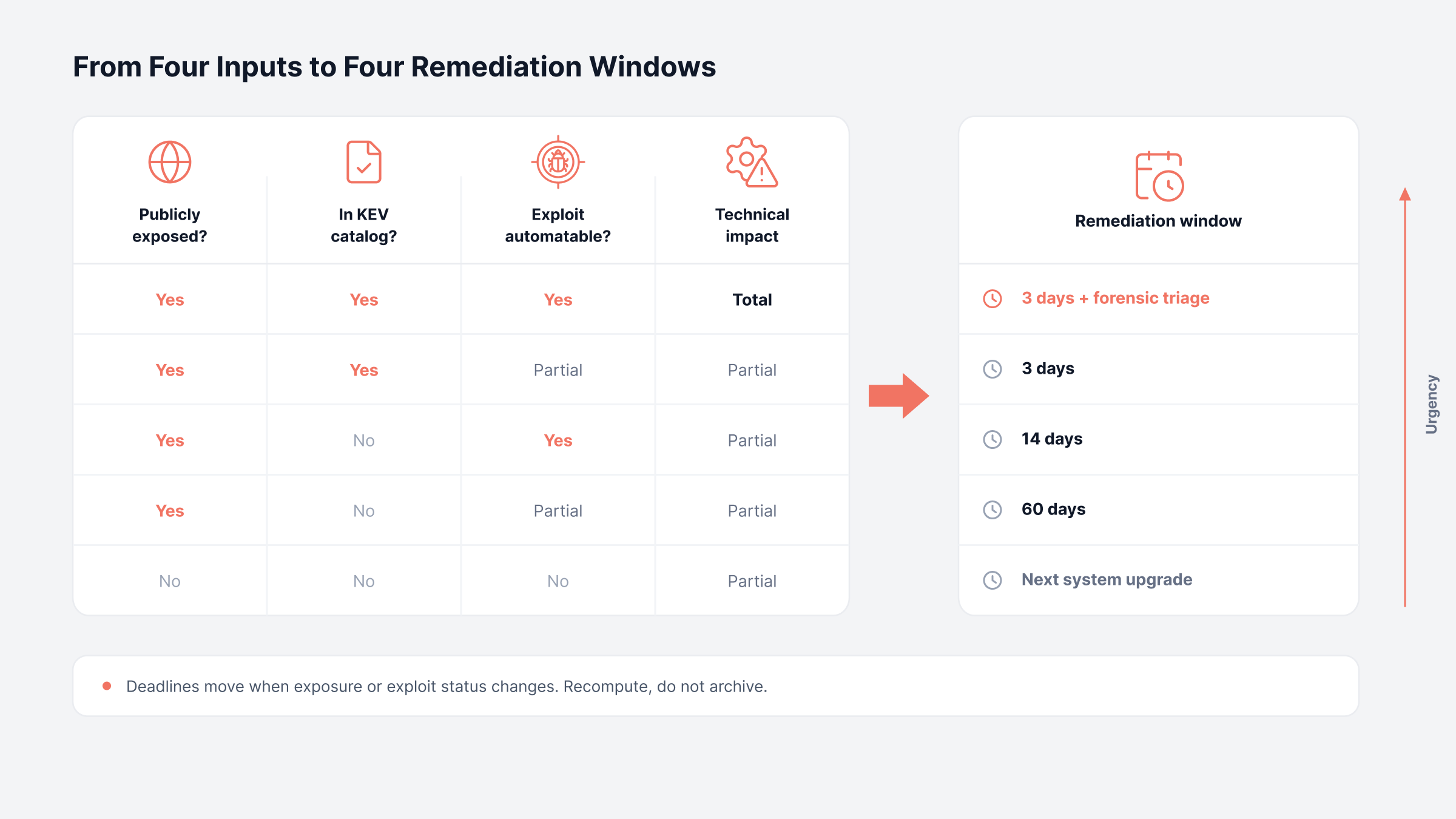
Remediation timelines should scale with exploitability and exposure, and the federal baseline for that model changed in June 2026. CISA issued Binding Operational Directive 26-04, which revoked BOD 22-01 and BOD 19-02 and replaced their flat deadlines with a risk-tiered matrix.
The directive scores every finding on four variables: whether the asset is publicly exposed, whether the CVE appears in the KEV catalog, whether exploitation can be automated, and whether it grants partial or total control. Those combinations resolve into remediation windows of three calendar days, 14 days, 60 days, or deferral to the next scheduled system upgrade. The most severe tier adds mandatory forensic triage to establish whether the system was already compromised.
Binding operational directives apply to federal civilian agencies, so most enterprises are reading this as guidance rather than obligation. It is worth adopting anyway, for two reasons:
It rations attention deliberately: CISA's own analysis at one large agency found roughly 1% of vulnerability instances landed in the three-day tier while more than 60% qualified for deferral
It converges with other regimes: Risk-based prioritization logic now runs through several regulatory frameworks, and the KEV catalog has become a de facto reference well beyond US government
Severity bands alone produce a queue nobody can clear. The matrix below shows how four inputs collapse into four remediation windows.
Stage 4: What Happens During Remediation and Mitigation?
Remediation closes a finding by deploying the vendor patch, applying a configuration change, or removing the affected component. Where none of those is available yet, vulnerability mitigation reduces exposure through compensating controls, and the vulnerability remediation record stays open until a permanent fix lands.
The vulnerability remediation workflow has more moving parts than the other stages combined, because it touches production. A patch needs approval, a test group, a maintenance window, and a rollback position before it goes anywhere near a fleet of endpoints. Change control belongs inside this stage, which is why change impact analysis runs in parallel for anything touching a critical system.
Trigger: A due date assigned during prioritization
Owner: IT operations, working within approved deployment policies
Output: A deployed patch, an applied mitigation, or a documented risk acceptance with an expiry date
Exit condition: Every finding in the batch has one of those three outcomes recorded against it
Three routes exist and all three are legitimate:
Patch: Apply the vendor fix through a tested and approved deployment policy
Mitigate: Restrict access, disable the affected feature, or add compensating controls where a patch cannot be applied yet
Accept: Record a formal acceptance with an owner, a rationale, and a review date
The third route is where programs quietly rot. An acceptance without an expiry date becomes a permanent exception nobody revisits, and legacy systems collect them faster than anything else in the environment. Deployment sequencing for workstation fleets follows the rules laid out for Windows patch management.
This is what one of our clients says about Motadata ServiceOps on G2, where the platform holds an overall 4.6 out of 5 rating across 29 reviews. A network security engineer describes the value as "all-in-one ITSM, ITAM, and Patch Management capabilities" in a 5-star review dated July 21, 2026.
Stage 5: How do you Verify and Report the Fix?
Verification confirms through a fresh scan that the finding count actually dropped, and it is the stage most often skipped. A deployment record proves a patch was sent. A rescan proves it landed and applied.
Reporting runs alongside verification because both draw on the same evidence. Auditors ask for timestamped records of what was scanned, what was found, when it was fixed, and who approved the exception. A standing audit log covers that request without anyone reconstructing history from email threads.
Trigger: Deployment or mitigation completes
Owner: Security, closing the loop it opened at Stage 2
Output: A rescan result, an updated posture report, and an audit record
Exit condition: The finding is closed in the same system that raised it
Compliance obligations attach here more than anywhere else. PCI DSS requires internal vulnerability scans at least once every three months under Requirement 11.3.1 and external scans by an Approved Scanning Vendor at the same interval, which sets a compliance floor. Our guidance on patch compliance covers what that evidence needs to contain.
What are the Common Challenges in the Vulnerability Management Lifecycle?
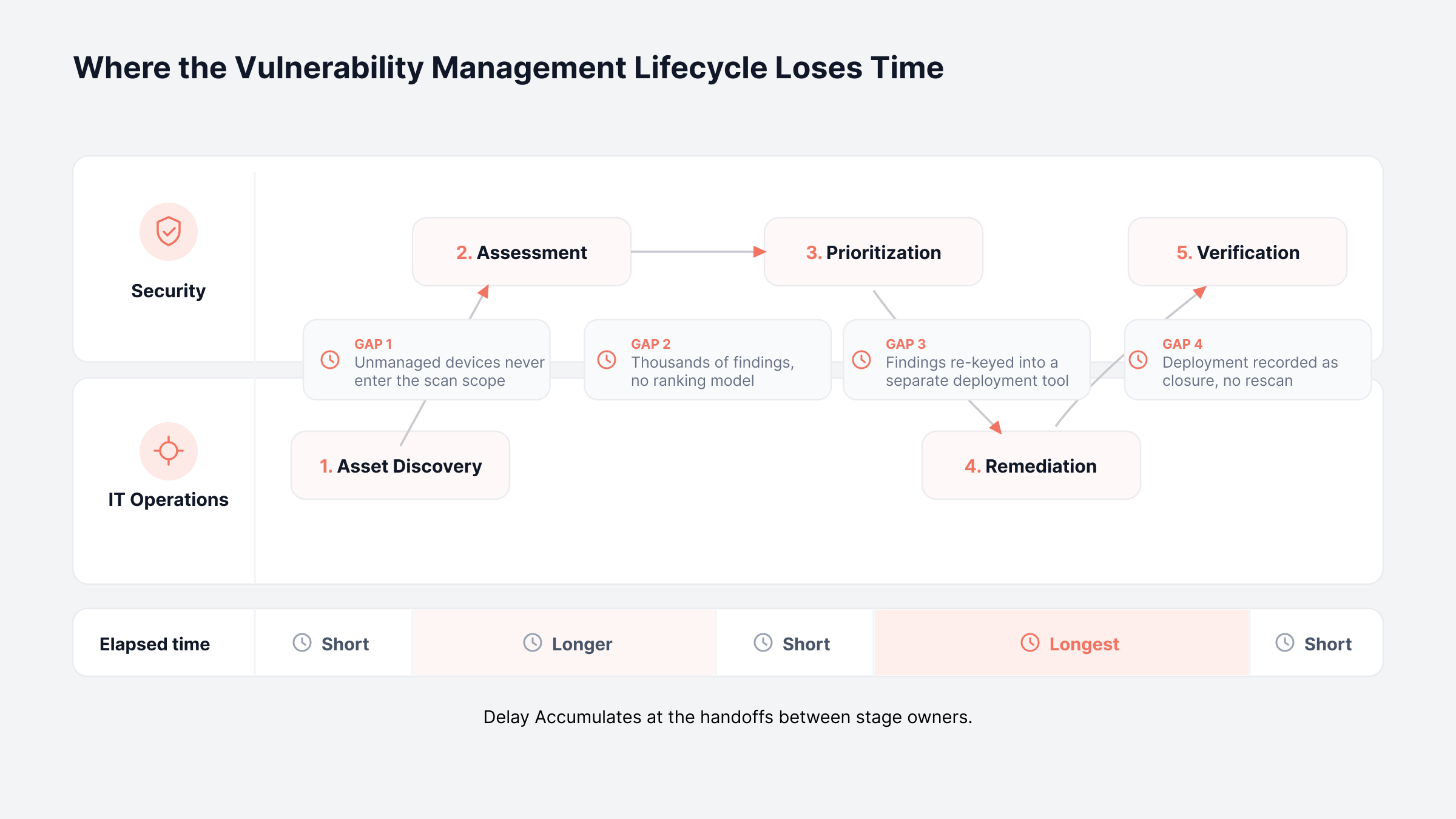
The common challenges in the vulnerability management lifecycle cluster at the handoffs between stages. Each stage tends to run reasonably well in isolation, and the days disappear in the gaps between one owner marking something done and the next owner picking it up.
Four failure points recur across environments of every size:
Discovery to assessment: Unmanaged devices never enter the scan scope, so the finding count looks healthier than the environment is
Assessment to prioritization: A first full scan returns thousands of records, and severity sorting alone produces a queue nobody can work through
Prioritization to remediation: Findings are exported, re-keyed into a separate deployment tool, and lose their identifiers along the way
Remediation to verification: Deployment gets recorded as closure, and nothing confirms the patch applied on every affected endpoint
The Log4Shell disclosure in December 2021 exposed all four at once, because the affected logging library was bundled inside commercial software that no inventory listed by name. The fastest responders were the ones who could answer where it was running before they started patching.
Naming a bottleneck is easier than seeing where the clock runs. The map below traces one finding across all five stages and marks where the elapsed days accumulate.
How do you Measure the Vulnerability Management Lifecycle?
Measure the lifecycle at the handoffs, using metrics that expose elapsed time between one stage and the next. A finding total on its own says nothing about whether the loop is closing.
Six measures give a program its picture:
Scan coverage: Percentage of inventoried assets scanned in the current cycle, which tests Stage 1 against Stage 2
Mean time to detect: Elapsed time from public disclosure of a flaw to its appearance in your finding list
Mean time to remediate: Elapsed time from detection to a verified fix, tracked separately per severity band
Remediation SLA attainment: Percentage of findings closed inside their assigned due date
Open exception count: Number of accepted risks currently past their review date
Reopen rate: Percentage of findings that reappear after being marked closed, which tests verification quality
Tracking the mean time to remediate as a single blended figure hides more than it shows. Split it by severity band, and the number for critical findings becomes the one worth reporting upward. The broader measurement set for the deployment side is covered in our breakdown of patch management KPIs.
What Makes Vulnerability Management Continuous Rather Than Periodic?
Continuous vulnerability management means the loop is triggered by events rather than by the calendar, so exposure surfaces within hours of disclosure instead of at the next scheduled run. Quarterly scanning made sense for infrastructure that changed quarterly, and very little now does.
Automated vulnerability management is what makes a continuous cycle sustainable at volume. Four triggers replace the schedule:
Database update: New published records prompt an immediate rescan of affected endpoints
Endpoint enrollment: A newly added device is scanned before it settles into normal operation
Inventory change: Installed software changes prompt a recheck of that machine
Post-remediation: A verification scan runs automatically once deployment completes
The handoffs are where automation earns its place. Routing a ranked finding straight into a deployment queue with its identifier intact removes the transcription step that costs most organizations their first week. Human judgment still governs which systems can take a patch during business hours, and it should.
Trigger coverage is also the first thing worth checking when you compare vulnerability management tools. A product that scans only on a schedule cannot support a continuous cycle, whatever the rest of the feature list says.
What are the Best Practices for Running the Vulnerability Management Lifecycle?
Best practices for the vulnerability management lifecycle center on governance more than on scanning technique, because detection is the part already working in most environments. Seven hold up at any size.
Give every stage a named owner: Assign a role to each of the five stages, and record it somewhere the service desk can see
Start the clock at prioritization: Attach a due date when a finding is ranked, so elapsed time is measured from the decision rather than from the deployment
Publish remediation windows by risk tier: Set them on exploitability and exposure, then hold the same tiers across every business unit
Give every exception an expiry date: A risk acceptance needs an owner, a rationale, and a review date, and it goes back into the queue when that date passes
Define closure as a passed rescan: A deployment record moves a finding forward, and only a verification scan closes it
Match cadence to how fast the environment changes: Compliance intervals are a floor, and environments with weekly software changes need detection that runs on events
Keep findings and deployment in one system of record: Every export to a spreadsheet is a place where identifiers, ownership, and due dates get lost
Two of these fail more often than the rest. Exceptions collect past their review dates, and closure gets recorded at deployment. Reviewing the open exception count and the reopen rate once a quarter catches both before an audit does.
Run Every Stage from Discovery to Verified Fix with Motadata ServiceOps
Most vulnerability products stop at the report and hand the rest to a separate deployment tool, which is exactly where the elapsed days collect. Motadata ServiceOps runs all five stages inside the service desk your IT operations function already uses, with vulnerability records sharing a CMDB with assets and tickets.
Detection updates daily from the Motadata Central Vulnerability Repository, and scans rerun when that database updates, when an endpoint enrolls, or when discovery data changes. Technicians can also run Scan Now against a specific machine. Scanning is agent-based and currently covers Windows endpoints.
Every finding carries a severity rating, exploit status, CVSS score, affected endpoint count, and patch availability, with a Fixable Vulnerabilities filter that brings patchable records to the top. Remediation hands off to the integrated patch management software module, where bulk approval clears every CVE tied to a single patch at once. A follow-up scan then confirms the count dropped before the ticket closes, with the Vulnerability Audit log and the Vulnerability Dashboard holding the evidence.
Which findings matter most to your organization is a judgment no platform makes for you, and business criticality and acceptable downtime stay with whoever owns the environment. What changes with ServiceOps is the distance between a ranked finding and a verified fix.
FAQs
What are the 5 stages of the vulnerability management lifecycle?
The five stages are asset discovery, assessment, prioritization, remediation, and verification with reporting. Some frameworks compress these into four steps or expand them into six, and the sequence of work stays the same.
What is the difference between the vulnerability management lifecycle and the vulnerability management process?
The two terms are used interchangeably in most practitioner writing. Where a distinction is drawn, lifecycle emphasizes the continuous loop and process emphasizes the documented procedure that staff follow inside it.
What is the NIST vulnerability management lifecycle?
NIST SP 800-40 Revision 4 frames the work as identifying, prioritizing, acquiring, installing, and verifying patches and updates across an organization. It treats patching as preventive maintenance and places verification inside the process rather than after it.
How often should the vulnerability management lifecycle run?
Detection should be event-driven, running whenever the vulnerability database updates, an endpoint enrolls, or inventory changes. Compliance frameworks such as PCI DSS set a quarterly floor for formal scans, which is a minimum, and a working cadence usually runs far tighter.
Who owns each stage of the vulnerability management lifecycle?
Security typically owns assessment, prioritization, and verification, while IT operations owns asset discovery and remediation. Assigning a named owner and a due date at every handoff matters more than which function holds which stage.
Author
Poonam Lalani
Content Strategist
Poonam Lalani is a B2B content strategist and writer with a background in computer engineering and experience across enterprise technology domains, including AI, cloud, DevOps, data engineering, and IT operations. She specializes in creating research-driven content that simplifies complex ideas and supports product education, thought leadership, and business growth.